The grooming environment is far more influential than most people realise. Before a single clipper blade touches fur or a brush makes contact, the space itself is already communicating volumes to the dogs in our care. A poorly designed environment can trigger stress responses, escalate anxiety and turn what should be a routine grooming session into a battle for everyone involved.
The good news? By understanding how dogs perceive their surroundings and making evidence-based adjustments, we can create spaces that actively support calm, cooperative behaviour. This isn’t about expensive renovations or complete overhauls either – it’s about strategic, thoughtful changes that acknowledge how dogs experience the world through their unique sensory abilities.
Why the Environment Matters More Than You Think
Before we dive into the practical tips, it’s crucial to understand the fundamental principle: dogs don’t experience environments the way we do. Their sensory world is dramatically different from ours, and what seems perfectly pleasant (or non-threatening) to us might be overwhelming, confusing, or even frightening to them.
Research in applied animal behaviour consistently demonstrates that environmental stressors significantly impact a dog’s ability to cope with handling and restraint (Döring et al., 2009). When we fail to consider the dog’s perspective in our salon design and daily operations, we’re essentially asking them to endure environmental stress, which we know is a recipe for escalating anxiety and reactive behaviour.
The holistic approach to grooming recognises that the environment is the foundation upon which all other interventions are built within a grooming environment. No amount of skilled handling or high-value treats can fully compensate for a space that fundamentally overwhelms a dog’s nervous system.
The Five-Sense Framework
I always begin environmental assessments using the five-sense framework: sight, sound, touch, smell, and even taste (though the latter is less relevant in grooming contexts). This systematic approach ensures we’re not missing critical elements that might be causing unnecessary stress.
Let’s explore each sense and how you can optimise your grooming environment accordingly.
Minimise Visual Clutter and Create Spacious, Breathable Environments
The Problem With Clutter
Dogs are instinctively programmed to thrive in open spaces where they can move freely, assess their surroundings, and escape if necessary. Our modern grooming salons, however, are often the antithesis of this natural preference and survival need. Compact spaces filled with equipment, products, crates, and decorative items that serve no functional purpose, are typical in most salons, especially multi-dog/multi-groomer ones.
There’s substantial research in environmental psychology demonstrating that clutter increases stress and cognitive load in both humans and animals (Roster et al., 2016). When applied to dogs in grooming environments, visual clutter creates multiple problems:
- Reduced escape routes: dogs feel trapped when they can’t identify clear pathways
- Increased vigilance: more objects mean more potential threats to monitor
- Spatial pressure: cramped quarters trigger stress responses, particularly in anxious dogs
Practical Applications
- Audit your space ruthlessly. Walk through your salon and question every, single item. Does this directly support the dog’s welfare or the grooming process? If not, remove it. Large decorative items, excessive product displays, and unnecessary furniture should all be reconsidered.
- Implement “breathing room” principle. Inspired by Feng Shui principles (which, whilst rooted in ancient philosophy, align remarkably well with modern spatial psychology) ensure that energy (and dogs) can flow freely through your space (Kennedy, 2020).
This means:
- keeping walkways clear and wide
- avoiding stackable crates that create visual walls
- positioning grooming tables with adequate space on all sides
- limiting the number of dogs (and people) in the salon simultaneously
Rethink your holding areas. Stackable crates are convenient for us but potentially distressing for dogs. Research on kennelled dogs shows that visual barriers and confined spaces increase cortisol levels and stress-related behaviours (Hennessy et al., 2001). Instead, consider:
- Spacious holding pens that allow natural movement (Five Freedoms, Animal Welfare Act 2006).
- Constant access to fresh water
- Familiar items (blankets, toys) to provide comfort
- Visual barriers between dogs to prevent staring and tension
Stagger appointments strategically. In multi-groomer salons, coordinate schedules to avoid having multiple dogs in the space simultaneously. This reduces barking, visual stimulation, and competitive stress.
Implement Dog-Friendly Colour Schemes Based on Canine Vision
One of the most common misconceptions is that dogs see in black and white. In reality, dogs have dichromatic vision which means they see primarily in shades of blue and yellow, with limited ability to distinguish reds, greens, and pinks (Neitz et al., 1989). Where we see a vibrant red toy on green grass, a dog sees varying shades of brownish-yellow – everything blends together.
This has significant implications for grooming environments. White surfaces, which reflect light intensely, can be difficult for dogs to assess spatially. Steel grooming bathtubs create visual confusion about where surfaces begin and end, potentially increasing anxiety and a reluctance to step onto them (Miller and Murphy, 1995).
The Energetic Dimension
Beyond the physiological aspects of vision, colour also carries energetic vibrations that influence mood and behaviour – a concept supported by colour psychology research in both humans and animals (Elliot and Maier, 2014). Whilst this might sound esoteric, there’s genuine scientific merit to considering how colour affects emotional states.
If we view dogs as “heart beings” – creatures who function primarily from emotional and social centres – then incorporating colours associated with the heart chakra (greens) makes intuitive sense (Griffiths, 2019). Even if dogs don’t perceive green exactly as we do, the energetic vibration may still influence their physiological state.
Practical Applications
Choose calming colour palettes. Opt for blues, purples, and soft greens in your salon design since these are colours that dogs can perceive and that research associates with calming effects:
- Paint walls in soft blue or lavender tones
- Select grooming table surfaces in blue or grey (avoid stark white)
- Choose towels and mats in blue or yellow (colours dogs see clearly)
Avoid stimulating colours. Red, organ, and bright yellow can energetically increase heart rate and arousal which is the opposite of what we want in a grooming environment (Yoto et al., 2007). These colours should be minimised or eliminated entirely.
Address reflective surfaces. Steel tables and white baths reflect light, creating glare and spatial confusion. Solutions include:
- Using coloured, non-slip mats on all surfaces
- Choosing grooming tables with textured, coloured surfaces
- Painting bath interiors in soft blue or grey tones
Prioritise Comfortable, Anti-Slip Surfaces Throughout Your Salon
The Critical Importance of Footing
A dog’s sense of stability is fundamental to their emotional state. When dogs feel insecure about their footing, their entire nervous system shifts into a vigilant, stressed state (Zink and Van Dyke, 2013). This isn’t merely about physical safety – it’s about psychological security.
Research on canine biomechanics demonstrates that slippery surfaces force dogs to alter their gait, increase muscle tension, and maintain constant vigilance to prevent falling (Carr et al., 2016). For dogs already anxious about grooming (or for dogs suffering an underlying medical condition), unstable footing compounds their stress exponentially.
The Paw Connection
Dogs’ paws are extraordinarily sensitive, containing numerous nerve endings that provide crucial proprioceptive feedback about their environment (Zink and Van Dyke, 2013). What surfaces feel like matters immensely to how safe and comfortable a dog feels.
Practical Applications
Invest in proper flooring. Commercial flooring often prioritises durability and ease of cleaning over canine comfort. Research specialist options like Floors for Paws, which has been tested and approved by Canine Arthritis Management for providing optimal grip and joint supper (CAM, 2021).
Lower surfaces strategically. Different areas require different solutions:
- Grooming tables: high-quality, textured rubber mats (avoid thin, slippery surfaces)
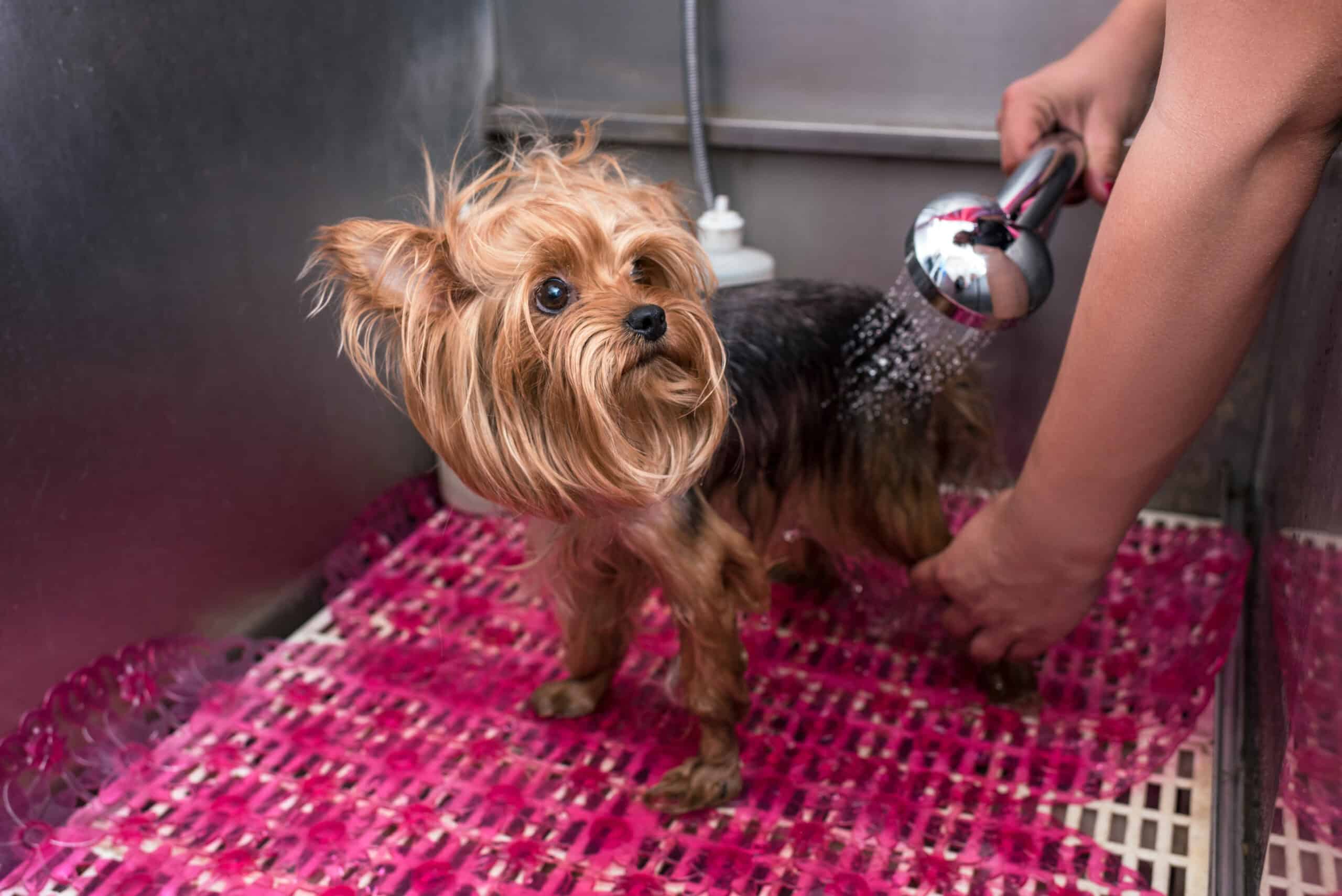
- Bath areas: textured yoga mats or specialist bath mats (never use bath grids – they’re uncomfortable and can trap nails)
- Floor work areas: foam yoga mats or fleece-covered cushions for dogs who prefer floor grooming
- Holding areas: soft, washable bedding that provides cushioning (vet bedding or even the dog’s own bed as a pacifier)
Yes, eliminate bath grids immediately. These are uncomfortable, uneven against sensitive paw pads, and pose injury risks if nails become trapped. Replace them with textured rubber mats that provide genuine grip.
Offer choices. Every dog has different preferences. Having multiple surface options available – different textures, thicknesses, and materials – allows you to accommodate individual needs and built trust through choice-based interactions.
Consider the ENTIRE journey. Think about every surface a dog encounters from entry to exit:
- Reception area flooring
- Walkways to the grooming area
- Surfaces around the grooming table
- Pathways to holding areas
- Outdoor secure spaces for toileting and breaks
Each transition point should provide secure footing.
Manage Auditory Environments to Reduce Noise-Related Stress
Dogs hear frequencies between 40 and 60,000 Hz, compared to humans’ 20 to 20,000 Hz range (Heffner, 1983). They can detect sounds from up to a quarter of a mile away and perceive subtle vibrations in sound waves that are completely imperceptible to us.
This remarkable auditory ability, whilst advantageous in many contexts, becomes a significant vulnerability in noisy grooming environments. What seems like moderate background noise to us can be genuinely overwhelming to dogs.
The Pain-Noise Connection
Recent research has identified a crucial link between noise sensitivity and chronic pain in dogs (Fagundes et al., 2018). Dogs experiencing pain are significantly more likely to display noise aversion, and exposure to loud sounds can exacerbate pain responses and trigger reactive behaviours.
This has a profound implication on grooming. If a dog is already uncomfortable (whether from arthritis, skin conditions, or the physical demands of grooming positions), loud noises can push them past their coping threshold much more quickly.
Practical Applications
Conduct an auditory audit. Spend time in your salon with your eyes closed, focusing solely on what you can hear:
- Multiple dryers running simultaneously
- Radio or music playing
- Dogs barking
- Staff conversations and laughter
- Equipment noise (clippers, scissors)
- A tumble dryer or dishwasher
- External sounds (traffic, neighbouring businesses)
- A phone ringing or a buzzer buzzing
Implement noise-reduction strategies:
Stagger noisy activities. Schedule your day to avoid having multiple dryers operating at once. If you have multiple groomers, coordinate so that one is bathing whilst another is doing quiet scissor work.
Create “quiet zones”. Designate areas for particularly anxious dogs where noise is minimised, away from dryers and high-traffic areas.
Choose equipment wisely. Invest in quieter dryers and clippers. Whilst they may cost more initially, the reduction in stress-related behaviour problems will save time and improve outcomes.
Manage human noise. Staff conversations, laughter, and phone calls all contribute to the auditory environment. Designate a staff area away from grooming spaces for breaks and social time.
Consider music carefully. Research by Wells et al., (2002) found that dogs display more relaxed behaviours when exposed to classical music, whilst heavy metal increased agitation. More recent studies suggest that Reggae Reggae and soft rock are particularly calming for dogs as well (Bowman et al., 2017).
Match frequency to intention. If you’re incorporating colour therapy principles (green for heart chakra), consider playing music in the 500-600 Hz range to complement those energetic vibration.
Use white noise strategically. Gentle white noise or nature sounds can mask sudden, startling noises from outside the salon.
Control Scent Environments to Honour Dogs’ Amazing Olfactory Abilities
A dog’s sense of smell is estimated to be 10,000 to 100,000 times more acute than humans’, with the ability to detect scents from over 15 miles away (Kokocińska-Kusiak et al., 2021). They possess up to 300 million olfactory receptors compared to our mere 6 million, and the portion of their brain dedicated to analysing smells is proportionally 40 times larger than ours (Horowitz, 2009).
This isn’t just about detecting smells, it’s about how scent shapes a dog’s entire experience of the world. Smell triggers memory and emotion ore powerfully than any other sense, which means that the scent profile of your salon can either support relaxation or trigger anxiety based on previous associations.
The Problem with Fragrance Overload
Many grooming salons are olfactory nightmares for dogs because they usually involve:
- heavily scented shampoos
- air fresheners
- perfumed cleaning products
- scented candles
- the smell of multiple people and dogs
All layered together in an enclosed space. For a dog with their heightened olfactory sensitivity this is genuinely overwhelming.
Research demonstrates that strong artificial fragrances can trigger stress responses and even respiratory irritation in dogs (Settles, 2016). When we add unnecessary scents to an already complex olfactory environment, we’re creating cognitive and sensory overload.
Practical Applications
Embrace “less is more” philosophy. The single most impactful change you can make is reducing unnecessary fragrances.
Eliminate artificial scents entirely:
- No air fresheners, plug-ins, or scented candles
- No incense or essential oil diffusers in grooming areas
- No heavily perfumed cleaning products
Choose fragrance-free grooming products. Whilst many clients request “nice smelling” shampoos, and even perfumes, educate then about the benefits of fragrance-free options for their dog’s comfort and skin health. Offer fragrance-free as your default, with scented products only upon specific request.
Manage personal fragrances. On days you’re grooming, consider avoiding:
- Strong perfumes or aftershaves
- Heavily scented lotions and/or hair products
- Scented laundry detergent on your work clothes
Ventilate effectively. Good air circulation helps dissipate unavoidable odours (wet dog, drying hair) without resorting to artificial fragrances. Invest in proper ventilation systems or air purifiers with HEPA filters.
Harness scent positively through Applied Zoopharmacognosy. Rather than imposing scents on dogs, allow them to self-select calming botanicals through Freework sessions. This evidence-based approach lets dogs choose which scents support their emotional state (Mills and Nankervis, 2013).
Allow acclimation time. When dogs first enter your salon, give them a few moments to simply explore and process the olfactory environment before beginning grooming. This reduced overwhelm and allows their nervous system to settle.
Bringing It All Together – The Holistic Environmental Way
Creating a low-stress grooming environment isn’t about implementing one or two changes but instead, adopting a holistic perspective that considers how every element of your space impacts the dogs in your care.
The Cumulative Effect
Each individual stressor might seem manageable in isolation. A dog might cope with slippery flooring or loud noises or overwhelming scents, but when combined, we rapidly deplete a dog’s coping capacity, pushing them toward their threshold much more quickly (Beerda et al., 1997).
By systematically addressing each sensory element, we’re not just making minor adaptions, we’re fundamentally enhancing the dog’s experience and their ability to participate cooperatively with grooming tasks.
Beyond the Checklist
Whilst these five tips provide a solid foundation, the most important skill you can develop is the ability to see your environment through the eyes of each and every dog that you care for, and this requires:
- Continuous observation – watch how each dog responds when they enter your space. Where do they hesitate? Where do they seem to relax more? And so on.
- Individual adaption – every dog requires a bespoke approach that caters to their very unique and individual needs.
- Ongoing education – stay up-to-date with research in canine behaviour, welfare science, and environmental design to ensure you continue to develop your own skills and ability to competency risk-assess your space.
- Collaboration – share insights with other professionals, especially professionals also responsible for the care of a dog you groom, and learn from the broader grooming and behaviour community at the same time.
The Professional Advantage
Groomers who invest in creating genuinely low-stress environments don’t just improve welfare outcomes, but also benefit from professional point of view as well.
Some benefits include:
- Fewer behaviour problems during grooming
- Reduced injury risk for both dogs and groomers
- Improved efficiency (calm dogs are easier to groom)
- Enhanced reputation and client loyalty
- Greater job satisfaction and reduced burnout
Your Next Steps
Start with an honest assessment of your current environment using the five-sense framework. You don’t need to implement everything at once, just prioritise the changes that will have the greatest impact for the dogs you see most frequently.
Remember: creating a low-stress environment is an ongoing process that will adapt with every dog, at every session.
The dogs in our care cannot advocate for themselves or request the changes they need in human language therefore it is our responsibility and duty to learn how to listen and understand to their canine communication signals in order to help reduce stress and make grooming sessions more enjoyable for them.
References
Beerda, B., Schilder, M.B.H., Van Hooff, J.A.R.A.M., De Vries, H.W. and Mol, J.A. (1997) ‘Manifestations of chronic and acute stress in dogs’, Applied Animal Behaviour Science, 52(3-4), pp. 307-319. doi: 10.1016/S0168-1591(96)01131-8.
Bowman, A., Scottish SPCA, Dowell, F.J. and Evans, N.P. (2017) ‘’Four Seasons’ in an animal rescue centre; classical music reduces environmental stress in kennelled dogs’, Physiology & Behavior, 143, pp. 70-82. doi: 10.1016/j.physbeh.2015.02.035.
CAM (2021) Canine Arthritis Management: Approved Products. Available at: https://caninearthritis.co.uk (Accessed: 20 November 2025).
Carr, B.J., Dycus, D.L. and Canapp, S.O. (2016) ‘Canine gait analysis’, in Zink, M.C. and Van Dyke, J.B. (eds.) Canine Sports Medicine and Rehabilitation. 2nd edn. Hoboken: Wiley-Blackwell, pp. 228-245.
Döring, D., Roscher, A., Scheipl, F., Küchenhoff, H. and Erhard, M.H. (2009) ‘Fear-related behaviour of dogs in veterinary practice’, The Veterinary Journal, 182(1), pp. 38-43. doi: 10.1016/j.tvjl.2008.05.006.
Elliot, A.J. and Maier, M.A. (2014) ‘Color psychology: Effects of perceiving colour on psychological functioning in humans’, Annual Review of Psychology, 65, pp. 95-120. doi: 10.1146/annurev-psych-010213-115035.
Fagundes, A.L.L., Hewison, L., McPeake, K.J., Zulch, H. and Mills, D.S. (2018) ‘Noise sensitivities in dogs: An exploration of signs in dogs with and without musculoskeletal pain using qualitative content analysis’, Frontiers in Veterinary Science, 5, p. 17. doi: 10.3389/fvets.2018.00017.
Griffiths, C. (2019) The Principles of Canine Flow. Available at: https://canineflow.com/insights/the-principles-of-canine-flow (Accessed: 20 November 2025).
Heffner, H.E. (1983) ‘Hearing in large and small dogs: Absolute thresholds and size of the tympanic membrane’, Behavioral Neuroscience, 97(2), pp. 310-318. doi: 10.1037/0735-7044.97.2.310.
Hennessy, M.B., Davis, H.N., Williams, M.T., Mellott, C. and Douglas, C.W. (2001) ‘Plasma cortisol levels of dogs at a county animal shelter’, Physiology & Behaviour, 62(3), pp. 485-490. doi: 10.1016/S0031-9384(97)00423-5.
Horowitz, A. (2009) Inside of a Dog: What Dogs See, Smell, and Know. New York: Scribner.
Kennedy, D. (2020) The Feng Shui of Spaces: Creating Harmony in Your Environment. London: Watkins Publishing.
Kokocińska-Kusiak, A., Woszczyło, M., Zybala, M., Maciocha, J., Barłowska, K. and Dzięcioł, M. (2021) ‘Canine olfaction: Physiology, behaviour, and possibilities for practical applications’, Animals, 11(8), p. 2463. doi: 10.3390/ani11082463.
Miller, P.E. and Murphy, C.J. (1995) ‘Vision in dogs’, Journal of the American Veterinary Medical Association, 207(12), pp. 1623-1634.
Mills, D.S. and Nankervis, K. (2013) Equine Behaviour: Principles and Practice. Oxford: Wiley-Blackwell.
Neitz, J., Geist, T. and Jacobs, G.H. (1989) ‘Color vision in the dog’, Visual Neuroscience, 3(2), pp. 119-125. doi: 10.1017/S0952523800004430.
Roster, C.A., Ferrari, J.R. and Jurkat, M.P. (2016) ‘The dark side of home: Assessing possession ’clutter’ on subjective well-being’, Journal of Environmental Psychology, 46, pp. 32-41. doi: 10.1016/j.jenvp.2016.03.003.
Settles, G.S. (2016) ‘The fluid dynamics of canine olfaction’, in Jezierski, T., Ensminger, J. and Papet, L.E. (eds.) Canine Olfaction Science and Law. Boca Raton: CRC Press, pp. 99-106.
Wells, D.L., Graham, L. and Hepper, P.G. (2002) ‘The influence of auditory stimulation on the behaviour of dogs housed in a rescue shelter’, Animal Welfare, 11(4), pp. 385-393.
Yoto, A., Katsuura, T., Iwanaga, K. and Shimomura, Y. (2007) ‘Effects of object color stimuli on human brain activities in perception and attention referred to EEG alpha band response’, Journal of Physiological Anthropology, 26(3), pp. 373-379. doi: 10.2114/jpa2.26.373.
Zink, M.C. and Van Dyke, J.B. (2013) Canine Sports Medicine and Rehabilitation. Ames: Wiley-Blackwell.