One of my biggest pet peeves is seeing a Facebook post flag up that says something along the lines of “Help! How can I speed up my grooming time?”. In the fast-paced world of professional dog grooming, time is often treated as the ultimate commodity. Conventional wisdom tells us that the more dogs we groom, the more money we’ll take home at the end of the day – but at what cost? Since when did quantity mean more than quality of care?
The Not-So-Hidden Risk of Rushing
Working under tight time restraints can increase the risk of accidents, both for the dog and the groomer.
When I think back to my school days I genuinely thrived at grasping and learning topics I was particularly fond of until it was time to sit in an exam room under the clock, and everything I had learned would suddenly disappear – I forgot important facts, I made silly mistakes, and my handwriting would appear messy and disorganised.
The difference is, rushing to complete an exam paper is nothing like rushing to complete a groom on a living dog!
The risks were a lot less risky in the safety of a room where there were no sharp objects that could, quite easily, cause significant harm. The worst that could have happened was that I failed the exam and had to resit. In the grooming environment however, rushing through processes can absolutely have catastrophic consequences.
A slip of the scissors could quite easily take a tongue clean off – this is not just a hypothetical risk, it has happened (more than a few times!).
Surely it’s common sense to say that being encouraged to speed up grooming processes is reckless and should absolutely not be a way to define how competent a groomer is.
So why is it considered such an important part of the job?
Groomer Burnout & What About Imposter Syndrome?
The pressure to meet unrealistic time targets doesn’t just comprise physical safety, it also impacts our emotional safety as well.
There’s a saying that goes, “work smarter, not harder“, and it’s one we should all be remembering on a daily basis because time restraints lead to over-exertion (physically and emotionally).
Think about it: in order to meet targets we might work longer days, add on additional days and/or even attempt to groom more than one dog a time! If we are making these decisions out of fear of not grooming enough dogs in a day (whether it’s fear of not being seen as ‘good enough’ or a fear of not earning enough, or something else entirely), we have to ask ourselves whether this fear is serving us and the dogs we are grooming, or only adding to our daily stress.
When you immerse yourself in a culture that measures success by quantity rather than quality, something else happens too – you begin to compare your own working day with your peers. You start to feel inadequate in your inability to match the number of dogs someone else says they have managed to groom. Suddenly, quantity translates to competency.
We focus so much on the number, that we don’t actually stop to ask the most important question of all: but how positive was each of those grooming experiences?
Because that matters.
You may push yourself to groom ten dogs a day but were those ten dogs struggling the whole way through the process, and were you? If the answer is yes, or mostly yes, that’s not competence – that’s recklessness.
Constantly pushing ourselves to go faster leaves us feeling exhausted, resentful, undervalued, and in many cases, questioning our suitability for the industry at all. It also puts an immense amount of emotional strain on the dogs we care for, which in my opinion, is a violation of our duty to protect.
Why Less Is more, More Often
Based on my experience and observations over the years, I’d say that in 80% of cases, less is more, more often.
To many, even the whisper of an incomplete groom is enough to kickstart hyperventilation, but hear me out!
When we are faced with a dog with additional needs, it is unfair to expect them to feel comfortable enough to endure a prolonged grooming session without careful adaption to the process.
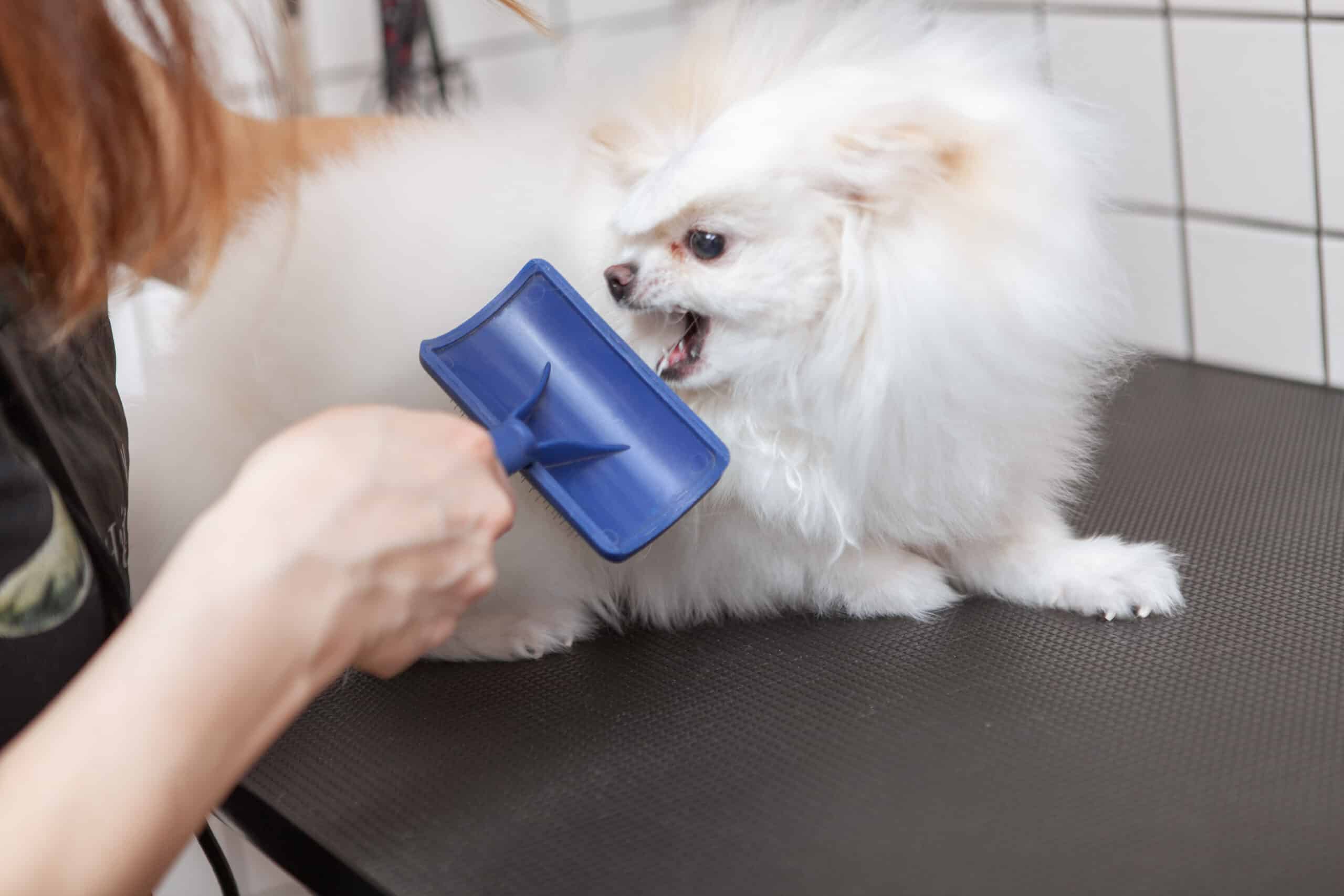
The conventional way of grooming doesn’t truly consider the needs of dogs at all, aside from the style – in mostly every aspect, it’s a clear process from A-to-Z that allows the groomer to feel in control and structured. The consequence of this approach is a high-stress, often, highly volatile environment where the risk of dog bites are high.
Because not every dog is the same.
For example, if we are faced with a dog with a specific medical condition, we can predict that grooming is going to be stressful and uncomfortable. The most humane way to comfortably groom a dog in this context, is to break up the session into smaller, more manageable chunks, over more frequent grooming sessions instead.
The benefits of this approach is that the dog learns that grooming will always be within their tolerance, and future sessions will be easier to manage.
On the flip side, if a dog learns that grooming is long and strenuous (or fast and intense) and that it involves over-restraint and force, they will anticipate the same with every new session, and you can guarantee that their behaviours will escalate and advance at a much quicker rate.
Eventually, that dog will most likely be deemed “unsafe to groom” and end up blacklisted and branded on a “Groomer Beware” Facebook page.
What then?
Charging Your Worth
A leading motivation for the cattle-market approach to conventional grooming practices comes down to business – groomers need to make money to earn a living.
So we are told that the typical Cocker Spaniel is charged on average between £35 and £45, and should take approximately 1.5 hours to groom (including health check, bath, brush, dry and styling).
I never ever understood this mindset because a groomer may be able to complete a groom on a well-socialised and healthy Cocker Spaniel in 1.5 hours, only to have a less confident one come in and take 2.5 hours because they’ve had to fight their way through the entire process! They now have to explain to the dog carer that they have to charge more to compensate for the extra time, which in turn results in one angry customer, and one traumatised dog.
Instead, I’ve always recommended that a groomer charge per hour and set a maximum time limit on how long a dog stays in the salon (my limit is 1.5 hours). That way, my clients know that the maximum they will have to pay for every session is £X. Additionally, they know to be available to call back at any point within that 1.5 hours (should a dog struggle, or should I require their assistance).
The problem isn’t really about not having the time to make enough money to pay the bills and some, but having the wrong approach to pricing in the first place.
If you can work out what you need to be charging per hour to cover your monthly outgoings and live a life that’s worth the hard work, the rest is easy.
Ultimately, carers aren’t paying for a completed groom – that’s the ideal scenario, and we must push for more awareness of that fact.
Our job is to ensure that the dogs in our care are cared for the best they possibly can be, and that their immediate needs are met.
The goal is to groom that dog and complete a suitable style based on the request of the carer, yes, but if a dog is too stressed to cope with the process beginning to end, it is both the responsibility of the carer and ourselves to help build up the dog’s confidence to grooming tasks to prevent unreasonable stress, and that takes a bespoke care plan.
Thankfully, more and more carers are understanding why the grooming experience for their dog is more important than achieving the perfect, flawless finish – unfortunately, many groomers still let fear dictate their actions.
Time Is Relative
There have been many well-intended groomers talk about ways they help reduce stress in the environment by extending time during grooming sessions.
The idea is that by allowing a dog to decompress during the grooming process, a groomer can complete an entire groom, over a longer grooming session – this can range from 2 hours to as much as 4 hours!
It looks something like this:
- dog arrives in the salon and in greeted by a freework session
- dog is then allowed time to initiate contact with groomer which opens the door to physical contact
- dog is introduced to brush, clipper etc., using positive reinforcements
- dog is placed in bath and given a quick once over with shampoo and conditioner
- dog is gently pat dried and allowed time to relieve himself and rest
- dog is then brushed wherever he is most comfortable
- dog is given more time to rest and
- dog is then introduced to dryer and begins the drying process
- dog is given a break mid-way through this process
- dog is reintroduced to dryer
- dog is finally dry and is given another rest break and opportunity to relieve himself
- dog is introduced to clipper and scissor work
- dog is given another break
- dog is reintroduced to clipper and scissor work
- dog needs another break
- dog is re-re-introduced to clipper and scissor work
- dog is finally ready for collection
While there are countless opportunities for the dog to relieve stress, there is a risk that the dog becomes overstimulated and overwhelmed with the process nonetheless.
Less is more, more often.
I’ve also witnessed well-intended groomers boast about providing shorter sessions (30-1 hour sessions) where they have completed full grooms through the use of physical restraints. They believe they have helped because the stress was “short and sweet”. The theory being: the quicker we get it done, the quicker they get to go home and relax.
But sadly, that’s not strictly true.
Exposure to acute stress through intensive, unsolicited interaction can cause just as much harm as an uncooperative, prolonged session.
Less is more, more often.
I always compare this to my experience giving birth to my first two children:
Child Number One: I went into labour, went to hospital and was lucky to receive some pain relief. The contractions lasted several hours but regular, and so the pain (while uncomfortable) was predictable and controlled. I was able to regulate because I could anticipate each surge and prepare for the pain to follow.
Child Number Two: I went into labour suddenly and was unable to receive any pain relief. I only felt one monumental contraction that never ended, and an hour and a half later I had my baby in my arms. But the pain was constant, and utterly excruciating because the contraction never left. My body had no rest, I couldn’t regulate and I was in considerable fear for my life. It was so horrific, I went into shock straight after and had to receive further medical assistance.
When people first heard that my second labour was quick, they would say, “Oh that’s great – you must have been relieved that this time it was quick”, and they were, obviously, so wrong!
The birth of my second son was far more traumatic than the more prolonged birth of my first. I felt in control of my contractions with Jack, but my body didn’t have a clue how to handle the one, never-ending contraction that came with Joey, and I went into a fight/flight response because I didn’t have any opportunity to regulate.
Assess The Individual Dog
The most important thing a groomer can do is individually assess every dog, at every new session.
Eradicating the pressure of completing an entire groom from beginning to end in one go, and making peace with the idea that an incomplete groom may be required, is key to preventing burnout and keeping the environment safe.
If you are going to use time in any way during grooming, my advice would be to use it to set a maximum time limit regardless of dog instead.
Having a maximum time limit is important since the average attention span of a dog is significantly lower than that of an adult human – when we consider that the mental and emotional capacity of a dog closely resembles that of a 2-3 year old human child, it goes without saying, that they will require more patience with high-stress tasks.
This isn’t a sign of your incompetence or inability to groom successfully – being able to identify the needs of dogs shows your knowledge in working with dogs in a science-led way. Contrary to what many people think, a groomer who knows when to stop a grooming session is a groomer demonstrating professional competency, and to me, that’s the true measure of success.