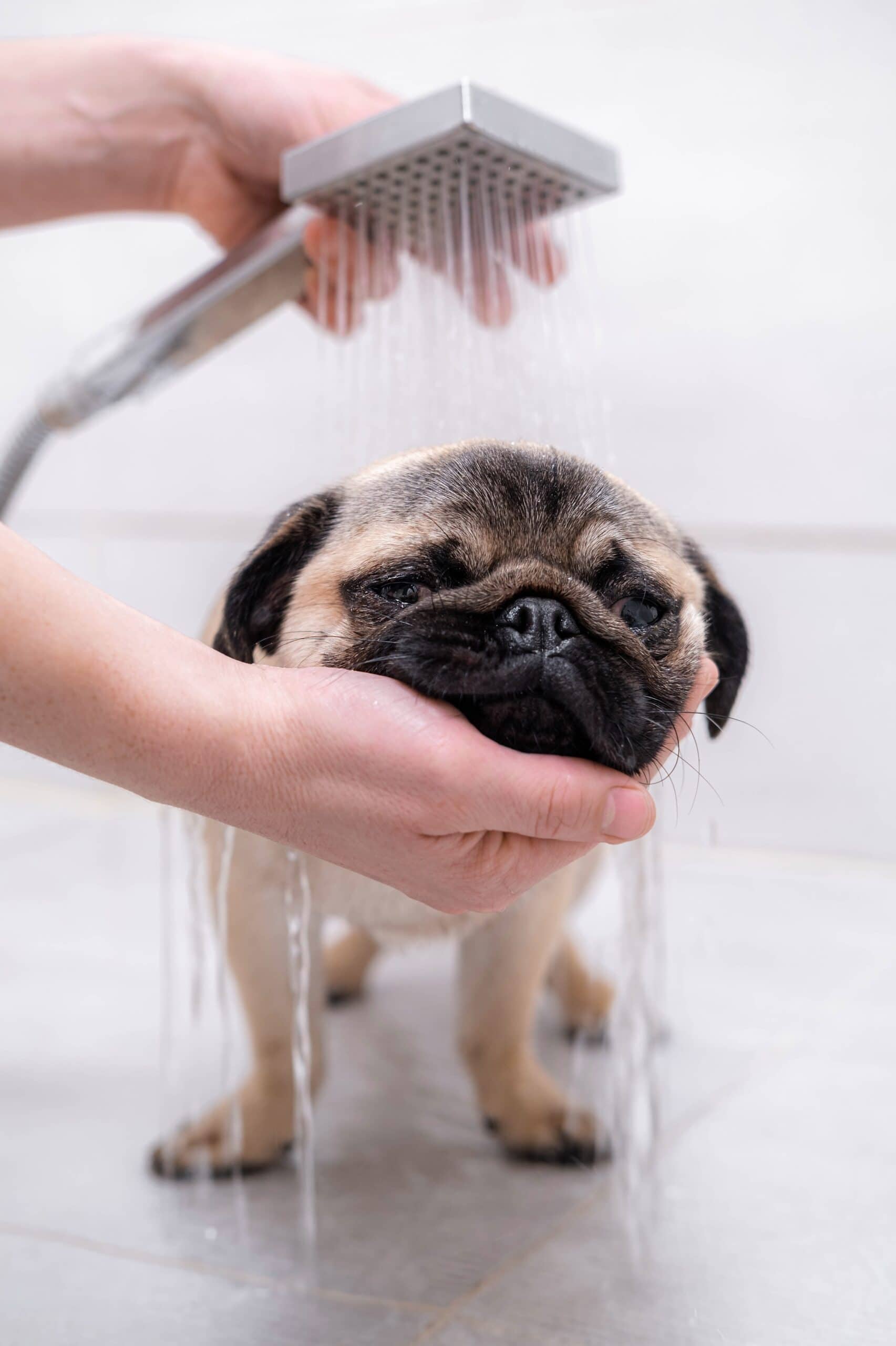
Professional grooming is a caring profession, but too often groomers pour empathy into dogs and clients while quietly running on empty themselves.
The Holistic Grooming Academy wants to change how the grooming industry approaches self-care for professional groomers with the introduction of their self-care module, available to every professional groomer for free. Groomers learn how to conduct a practical and reflective mind/body/spirit reset, helping the groomer to build a self-care framework that supports their wellbeing and their long-term success in the grooming industry.
Why self-care is the most overlooked skill in professional grooming
Groomers are often deeply empathetic people, and while our empathy makes us brilliant at reading dogs, it can also make us terrible at prioritising ourselves.
The outcome is predictable:
- chronic fatigue
- tension injuries and pain
- anxiety, headaches, overwhelm
- reduced focus and increased accident risk
- total burnout and, eventually, compassion fatigue
Self-care isn’t a luxury. In grooming, it’s a form of risk management for both the dog on your table, and you!.
Why humans could benefit from being more like dogs
One of the core practices we introduce early in our self-care module is learning to check in with ourselves, consistently throughout the day because a lot of what we feel lives in our subconscious, and only comes to the surface when we are exposed to stressful scenarios.
When this happens, we react, we push through, we suppress, we carry on, and then we wonder why burnout hits like a wall.
If left alone, dogs feel and express in the moment – they have no issue with allowing their internal state to transfer to their external.
Humans, on the other hand, are plagued with conscious awareness – we often train ourselves to stop feelings before they reach the outside. We believe that in doing so, we prevent catastrophe when the reality is that, we only add to the storm.
This is significant because dogs can feel our internal emotional state regardless of how good we are at trying to conceal it from the public eye – this means, how we feel has a direct influence on how the dog in front of us, also, feels.
The good thing about having the ability to consciously think is that, when used purposefully, we can train ourselves to acknowledge how we are feeling before it becomes a problem, and do something proactive about it, even if it’s just one or two minutes of deep breathing.
Tip #1 – The self-check-in exercise
Checking in with yourself if incredibly simple, all you need to do is:
- close your eyes
- breathe in through your nose and into your diaphragm
- hold for a few seconds and ask a question that helps you notice what you are feeling right now
- breathe out through your mouth
- and note down what thoughts came to mind
Examples include:
- “How am I feeling in this moment?”
- “What do I need today to feel supported?”
- “What could I change this week to improve my daily routine?”
- “Where in my body feels tense?”
Having a journal nearby to write whatever comes up can be an incredibly powerful way to self-reflect and identify common triggers that could help you to support your self-care journey going forward.
Tip #2 – How to turn self-care into a habit without making it a chore
Here’s one of the most practical tips we teach students: use a daily trigger.
When we used to send students welcome packs, one of the things we would include was a sleeve of colourful sticker dots – the idea was for groomers to stick a dot in random places throughout their grooming salon, to act as a trigger to check-in, say an affirmation, or give gratitude for something in their life.
Instead of trying to “find time”, the dots act as a quick reminder to check in with ourselves while doing the things we would already be doing.
These dots could be placed in other areas as well, and don’t necessarily need to be reserved for the work environment, for example, the dots could trigger a self-care activity:
- every time your get in the car
- every time you go to the toilet
- while the kettle boils during your break
- before you hop into bed
Because that’s how habits stick: trigger → action → repetition.
The self-care decision most groomers avoid
Do you know the difference between your needs versus your wants?
One of the key learning outcomes for our self-care module is being able to recognise when we compromise our needs, sometimes without ever realising it, for getting something we want.
Here’s a grooming-specific example we use:
- Want: the newest expensive shears (because we believe this will somehow make us perform or look better)
- Need: a chiropractor or physical support because our back is hurting daily (but we can’t justify the money on something for us)
And this isn’t about guilt, it’s about awareness of these behaviour patterns, and what they represent.
We often disconnect our own needs, and the role we play, and solely associate tools and equipment with the success of our business – we fail to recognise that we are the most expensive (and irreplaceable) tool in our kit.
So we teach students all about intelligent compromise because when understand that an investment in what our body needs, is the same as an investment into our business because it enables us to perform to the very best of our ability.
Once our needs have been met, we can look at what we want.
Our grooming environment shapes our health (and the dog’s stress)
Self-care isn’t only personal, it’s an informed decision for business productivity and the experience a dog has while spending time with us.
The grooming environment itself has a massive impact on the groomer’s physical and emotional wellbeing.
Key environmental factors you should consider include:
- Lighting: Harsh LEDs can contribute to headaches. Natural light is often better where possible.
- Temperature, Humidity & Ventilation: Pods, sheds, and small salons often trap heat and moisture. Poor ventilation worsens fatigue and sensory overwhelm.
- Noise Pollution: High-velocity dryers are loud. Multiple dryers at once can create constant stress for groomers and dogs.
- Workload Pressure: If the salon runs like a “cattle market,” stress rises for everyone. More dogs doesn’t automatically mean more success, especially if our health collapses.
This is where holistic grooming becomes more than just grooming dogs, it’s also about designing a space that helps the nervous systems stay regulated.
Tip #3 – How to prevent sensory overload
When stressors, such as those listed above stack up, they can push the body into sensory overload, leading to:
- a shorter fuse and frustration
- reduced focus and increased mistakes
- headaches and worsening chronic conditions
- escalated stress responses in dogs (snapping, lunging, shutdown)
All of which can be avoided through a more carefully planned self-care routine that considers the groomers individual needs and preferences.
The impact of welfare and neglect cases
A powerful part of what we teach is acknowledging the mental toll of the many difficult cases we are faced with over our career-span.
This can be anything from:
- severe matting in dogs
- dogs that are nearing end of life
- rescue/rehoming dogs needing comfort grooms
- carers who don’t follow aftercare and continue to let their dogs suffer
- dogs that are struggling with medical conditions that make grooming difficult for them
- carers who practice outdated dog care and are unwilling to learn an alternative way
And the list goes on.
We understand how important it is for groomers to aspire for strict boundaries and limitations to reduce the frequency of their exposure to troubling cases, or alternatively investing in their recovery should they choose to specialise in such cases.
Additionally, it’s often about:
- educating carers where possible, in an approachable and non-judgemental way (more on this here).
- creating clear policies (matting policies, disclaimers, homework expectations) that are explained from the beginning
- deciding on ethical boundaries: can we realistically cope with repeat neglect cases, or is it too emotionally burdensome?
While we all want to help everyone and every dog, there’s no failure in protecting our own wellbeing.
I personally recommend Tamsin Durston’s book, ‘Emotional Wellbeing for Animal Welfare Professionals‘ as a further resource for managing the emotional load of working within animal care roles, and you can also find a few free resources featuring Tamsin in both the HGA Library and Membership via their Skool community.
How do we commit to self-care?
At the HGA, we summarise five areas that create sustainable wellbeing and work-life balance.
These are:
- healthy eating
- quality sleep
- physical fitness
- emotional & psychological wellbeing
- spiritual health (which can have various different meanings for different people)
And we repeatedly reinforce our core holistic message:
everything is connected.
Sleep affects focus. Diet affects mood. Emotional wellbeing affects the dog. The salon environment affects the nervous system.
And ultimately, one weakened pillar, weakens the others.
The performance triad we can’t ignore
- Healthy eating: We frame nutrition as brain fuel – a nourishing diet supports concentration, mood, and long-term health. We encourage groomers to aim for good choices most of the time, but leave room for enjoyment.
- Quality sleep: We connect sleep to grooming safety – reaction time matters in a high-risk environment where sharp tools are being used on living, moving beings. Better sleep supports quicker responses, fewer mistakes, and better emotional regulation.
- Physical fitness: Our most important takeaway is to find what you enjoy because if you hate it, you won’t stick to it.
Intuition, connection, and compassion (without forcing beliefs)
We’re careful to describe spirituality as a very personal thing – for some it may represent a religion and/or culture, for others it might mean:
- intuition and inner voice
- compassion and empathy
- connection to the wider world
- meaning and ethics in how we relate to animals and humans
The goal isn’t to persuade or to preach, but to instead invite exploration with an open mind, for groomers to then decide what makes sense to them.
Free Resource: ‘The Emotional Cup’ Exercise
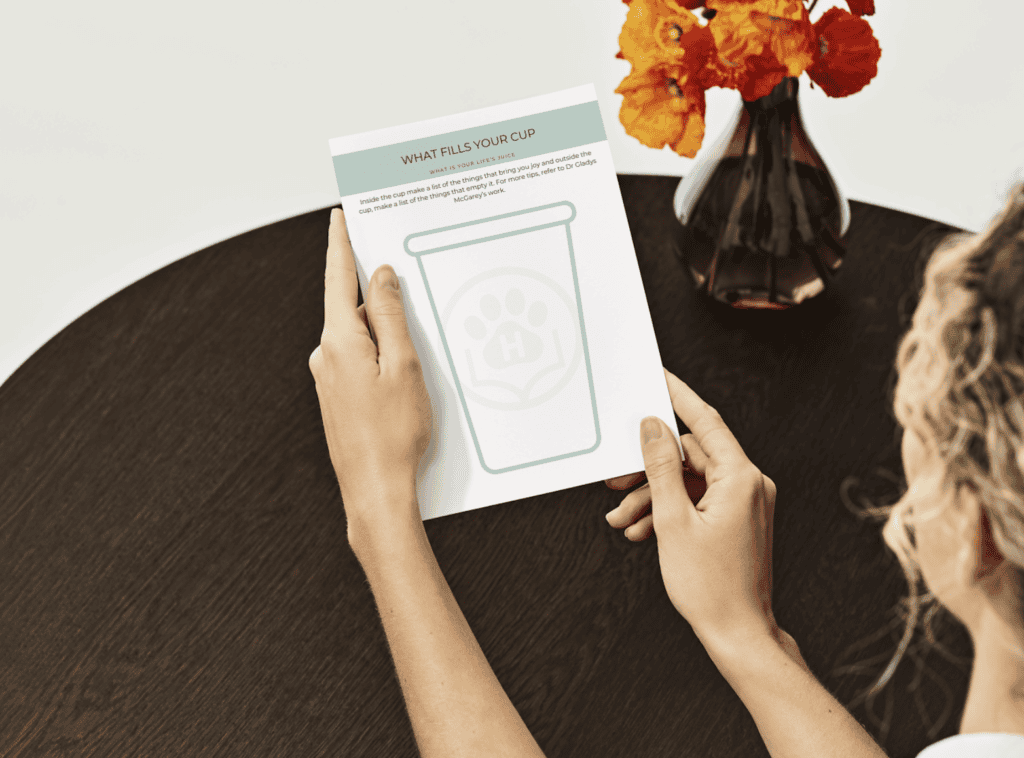
The free worksheet is available to download here.
It’s brilliantly practical for groomers who struggle to set boundaries because it provides them with something visual that they can intently add, and then refer, to.
First you think about the things in your life that fills you full of love, motivation, inspiration and hope, and you write them all inside the cup.
Next, you think about all of the things in your life that drains you of your life’s juice – things that prevent you from being you, that make you sad or frustrated, and that kill your inspiration – and you write them all down on the outside of the cup.
This exercise was inspired by Dr Gladys McGarey, author of ‘The Well Lived Life‘, who actively encourages her own students to utilise the Cup exercise through her own template.
It works because it helps us to recognise whether a request, client, schedule, or habit is nourishing or depleting, so we can practice saying “no” with clarity, rather than guilt.
Further Learning
If you would like to sign up for the Self Care Module and begin your own journey into a more self-centred grooming business, join our Skool community here to get started!
Note: I earn a small commission (at no expense to you) for any of the books purchased using the links above.