Earlier today, I came across a sponsored reel that was advertising a duck-shaped muzzle for barking dogs, and across the screen appeared the words:
POV: What happens when you won’t stop barking at everything
The accompanying audio repeatedly sang the words “Shut the F*C#K Up!”, while the caption prompted the viewer to comment “NEED” if they needed one for their dog (see screenshot below).

There was a time that I would have laughed it off and kept on scrolling, like so many others were doing, but all I saw today was the missed opportunity to help dog guardians understand WHY their dog barks, and that made me sad.
Because this particular advert was, unintentionally, sending out a message to the world of dog guardians that barking is a problem behaviour, and that perhaps, a quiet dog makes a good dog.
And the more I sat with that thought, the more I realised that our perception of good/desired and bad/problematic behaviours don’t stop at dogs barking.
- tomorrow it might be growling
- the day after, it might be pulling on the lead or walking too slow
- the next day, it might be a dog struggling on the grooming table
- or a dog refusing to walk through the veterinary practice door
What I’m seeing more and more in dog guardianship today is that the behaviour gets the blame, while the cause goes unidentified.
It made me wonder…
Have we always aimed to stop what we consider to be “bad” behaviour before understanding why the behaviour is there in the first place? Or is this something that has been gradually, and very cleverly, conditioned into us over several years?
Humour isn’t really the issue…
Before I go any further, I think it’s important to be fair.
This isn’t an attack on one company, brand or group of people, and it’s certainly not an argument against the responsible use of suitable muzzles. There are, of course, situations/contexts where a muzzle can be useful (so long as they are positively introduced, comfortably fitted and safe to use).
Equally, I’m not suggesting people should stop seeing the joy and laughter in sharing our home with dogs because I know all too well, how endearingly humorous dogs can be.
Dogs do make us laugh every day – sometimes they do gloriously ridiculous things, sometimes they are utterly chaotic, and sometimes they are so perfectly timed in doing something hysterical you couldn’t have timed it better if you tried.
When used mindfully, humour can bring us closer to our animals and to one another – it can help us feel less alone in day-to-day challenges, for example. But when we use humour to normalise and/or condition ourselves into thinking that behaviour is merely surface-level – good or bad – we risk compromising welfare.
The things we learn to laugh at, the things we, in turn, dismiss, the things we roll our eyes at and find frustrating, the things we label “naughty”, “stubborn” or “diva” – shape the way we view dogs, and they influence how we care for them.
Over time, those ideologies that silently sit behind the jokes, contribute significantly to the quality of life a dog has, and perhaps this is why I found this particular reel important enough to write a post about.
The entire premise relied upon one simple but catastrophic assumption:
Barking dogs themselves were the problem.
Newsflash! Your dog doesn’t have a barking problem…
Barking isn’t the issue – there I said it!
The issue is what the barking actually represents.
I completely understand why so many people ask Google: “How do I stop my dog barking?” – societal pressures can be extremely challenging to manage.
One of the main reasons dog guardians seek to stop barking, for example, is because they have received a complaint from their neighbours – coincidently, I’ve been there and I know firsthand how desperate it can make you to find a resolution fast.
It can also be family pressures – welcoming a new baby into the home brings with it many sleepless nights, and exhaustion can make, even the smallest thing, seem monumental and unbearable.
Whatever the reason may be, as I’ve mentioned, it’s not the behaviour that’s the problem.
Instead of typing into Google:
- How do I stop barking?
- How do I stop my dog pulling?
- How do I stop my dog growling?
- How do I stop my dog from jumping up?
- How do I groom my dog without him resisting?
- How do I stop my dog from sniffing every lamp post?
Instead of seeking a way to stop the behaviour you consider to be a problem, wouldn’t it make better sense to understand why the dog is barking in the first place?
While “how do I stop…?” seeks to remove the symptoms, “what is my dog barking/pulling/growling at, and why?” seeks to understand the cause.
There’s a significant distinction between these two questions which I hope you can now clearly see.
The issue with certain words
If we look back at the wording used in the advert, “what happens when you [the dog] won’t stop barking” –
The word “WON’T” implies that dogs have a choice when it comes to how they behave, and is suggesting that they choose to bark because they want to, out of stubbornness or revenge perhaps? Well actually, no…
This choice of word paints a picture of defiance and disobedience.
But if we change the word to “can’t”, notice how it instantly feels different:
“What happens when you[the dog] can’t stop barking”
Instead of assuming deliberate refusal to behave, the viewer is invited to become curious as to why the dog can’t stop barking.
This can help prompt us to asking the right questions:
- why can’t they stop barking?
- what’s happening to my dog to cause him to bark?
- what is my dog experiencing right now?
- how is my dog feeling?
- is my dog afraid, frustrated, worried, excited?
Real Life Example
I was recently introduced to a lovely Red Irish Setter who was staying at my sister’s while his family were on holiday. In the hour I visited, all he did was whine. My sister insisted that this was “normal behaviour” and that he was endearingly nicknamed “Red Whine” because that’s all he ever seemed to do.
This is a prime example of how humour can compromise welfare.
I was instantly concerned because dogs don’t whine unless they are distressed, or whining behaviours have been reinforced positively over time.
When I got closer to him, I quickly identified that he was significantly underweight and his coat was covered in thick matts. I advised my sister to tell his family to book a vet assessment as soon as they get home.
With this example in mind, changing the words we use to describe what we see can completely change the way we view and assess the situation in front of us.
Rather than assuming that the dog is a drama queen or attention-seeking, we can instead ask “why can’t my dog stop whining?”.
From this question alone, we can begin to problem solve:
- could he be in pain?
- could he be anxious?
- could he be hungry?
- could he be over-stimulated?
Questions that are crucial in helping to get to the reason why the dog is behaving in this way.
Behaviour is the symptom…
The issue with the advert was that it suggests that if we stop the behaviour, we resolve the cause, and it’s a really easy assumption to make, especially if you’ve never trained in Canine Behaviour before.
On the face of things, stopping a barking dog from barking through corrective tools, like muzzles, might resolve the problem you have with neighbours complaining but it hasn’t resolved the underlying need your dog has that’s affecting them.
This is where I like to use the analogy of the smoke alarm:
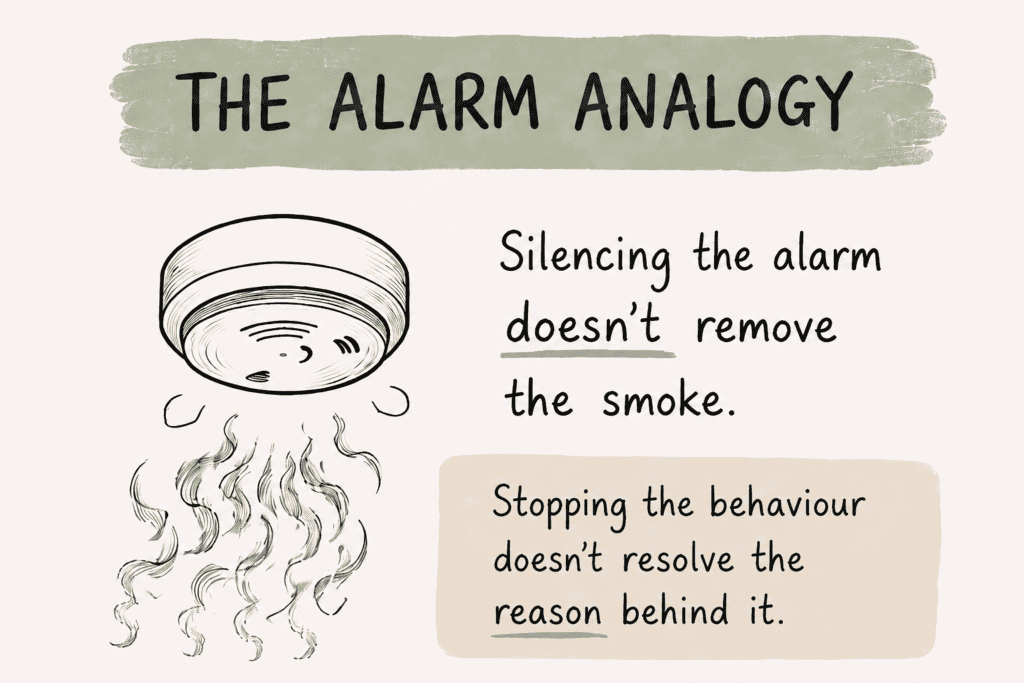
If there’s a fire and your smoke alarm goes off, you can silence the alarm, but the smoke will still be there unless you put out the fire.
When I’m trying to explain this to students, I often use the example of a smoke alarm. Imagine there’s a fire in your house and the smoke alarm starts going off. It’s loud, it’s annoying and you desperately want it to stop. Of course, you could silence the alarm. But doing that wouldn’t remove the smoke. The smoke would still be there and continue to advance, unless you dealt with the fire.
I often wonder if we approach dogs in much the same way. Barking, growling, pulling away, struggling on the grooming table or refusing to walk into the veterinary practice can all become the ‘noise’ that we want to silence. But if those behaviours are the dog’s way of telling us that something isn’t right, stopping the behaviour alone doesn’t necessarily resolve the cause behind it.
Chances are Google is not going to be able to accurately identify the reason behind your dog’s barking habits, but it may have led you to my post where you will, at the very least, discover some potential triggers that might just point you in the right direction.
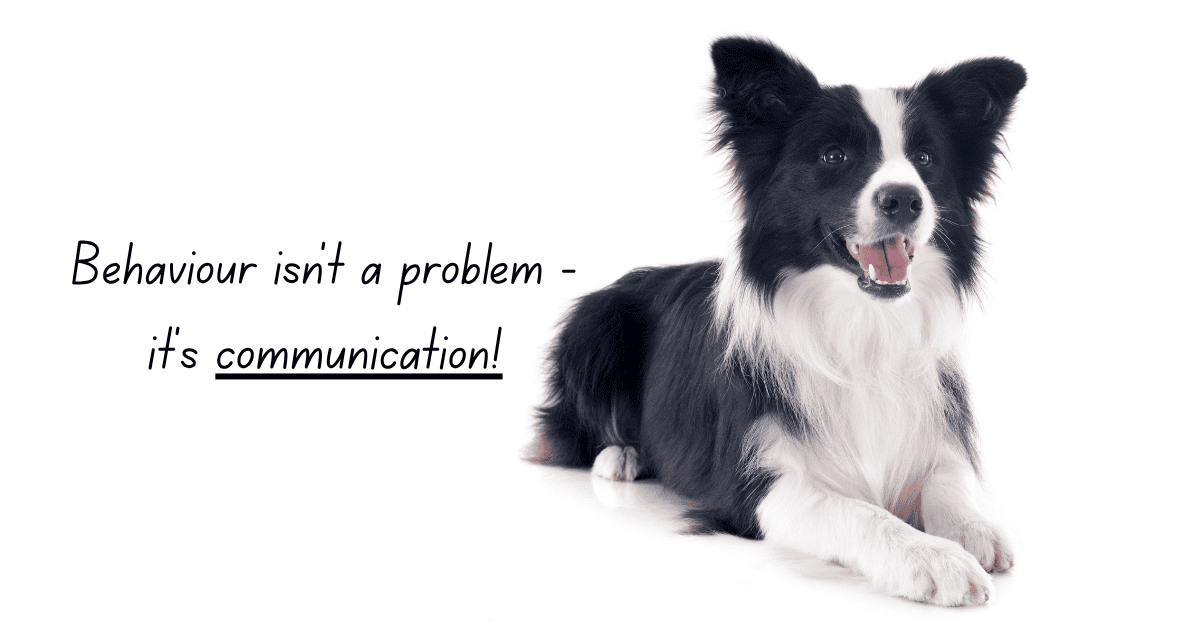
When we see behaviour as communication, we can understand first that our dog is trying to tell us something.
Recognising the moments on the lead up to the behaviour can be incredibly revealing – in many cases where a dog barks, it’s because they have observed something and they want to tell you all about it.
For example, your dog is spending some time in the garden and sees a cat walking along your garden wall.
If your dog has never been socialised to cats, there is a big chance the sight of one will ignite a reaction – your dog will most likely bark to tell the cat to stay away from his territory and/or to alert you to the feline intruder.
Knowing that your dog is aroused by the sight of cats can help you to relieve/resolve the cause thus prevent behaviour going forward – you have two options:
- You start desensitising your dog to cats using positive reinforcement (this is the most effective, long-term solution)
- You limit and monitor your dog’s access to the garden to reduce the likelihood of him seeing the cat (this would be quite difficult to control but is good for short-term management while you work at option number 1).
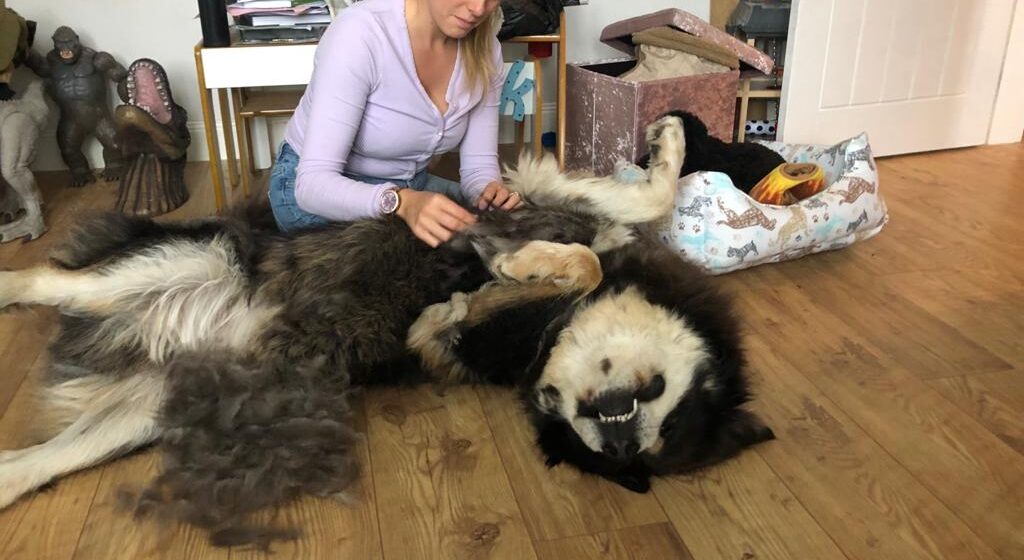
Equally a dog might bark when they are inviting another dog to play – in my own experience, many times my dogs barked was during play and given that they were Tibetan Mastiff’s, the noise they made could be quite loud and aggressive!
Behaviours, context and reasons vary from dog to dog and it’s our job to observe and analyse our dogs’ behaviours.
Natural behaviour vs welfare concern
A common theme in dog guardianship today is in how we classify behaviours.
Many behaviours our dogs exhibit are completely natural, normal and healthy when coming from a species-specific perspective.
For example:
- A dog barking at people walking past the window becomes a problem because the sound frustrates us or our neighbours.
- A dog who stops to sniff every lamppost he passes becomes a problem because we are in a rush to get back home.
- A dog who wriggles and resists handling during a grooming appointment becomes a problem because we are being paid to get the job done within a specific time frame.
- A dog who growls when someone reaches towards them becomes a problem because it makes us feel threatened and at risk of being bitten.
- A dog who won’t walk into the veterinary practice becomes a problem because we are going to be late and potentially miss our appointment.
In every example above, behaviour is defined “problematic” because we are focused on what we feel, need, want and/or expect.
But to dogs, behaviours are a very natural, reflexive response to their internal feelings – there’s no logical thought processing involved.
This isn’t a criticism to humans – we are predisposed to be human-focused after all – but it is a nudge to start thinking through the lens of a dog.
While it’s also true that any behaviour can escalate to a point where welfare is indeed compromised, it’s important that we learn ways to distinguish between what is healthy and what is a welfare concern.
Using the first of the examples above:
- Allowing a dog to bark at every person that walks past the window is, indeed, a welfare concern – not because barking is a problem, but because anytime he sees a person causes him a sense of dis-ease. Rather than punishing/correcting the behaviour (barking) we can conceal the window and/or move the dog to a more suitable room in the home.
Grooming contexts taught me a lot about expectations
If I’m honest, I don’t think I truly understood the harm in labelling behaviours until I became a groomer.
It’s one thing talking about behaviour in theory, it’s another thing standing beside a distressed dog on the grooming table who is desperately fighting against every restraint you place on them.
It’s incredibly easy, particularly when appointments are running behind and another client is due through the door, to start viewing resistance as obstacles to control and overcome:
- How do I stop him pulling away?
- How do I keep his leg in position?
- How do I dry him as fast as possible?
- How do I scissor the face without cutting his tongue off?
- How do I get this groom completed in the time I have allocated?
While these questions are reasonable if not for the grooming outcome but from a safety perspective, they don’t acknowledge the experience the dog is having and how this is influencing the behaviours that are holding us back.
At first glance, the most obvious and efficient solution might be:
- another restraint
- a more firm hold
- an additional groomer to help stabilise the dog
But a finished haircut isn’t evidence that we did our jobs well, or even safely.
I realised very quickly that the quick fixes didn’t fix anything at all, they just add to the stress the dog (and you) are experiencing.
Prevention of behaviours is not the same as controlling them.
Prevention of behaviours looks more like careful desensitisation, counter-conditioning and positive reinforcement.
Understanding canine behaviour requires you to read between the lines
Another huge pain point for dog guardians is walking on the lead.
How often do we describe a dog as being a “bad walker”? I still catch myself saying it every now and then when talking about my Dachshund, Honey (who acts feral whenever she sees a dog across the road).
The reality is that dogs who pull are pulling for a reason too, and in many cases it’s a result of over-stimulation and a lack of early socialisation.
Dogs that pull hard, zigzag and/or lag behind might make walking challenging for us, but understanding that there’s two ends to the leash helps bring us back down to Earth.
I recently had the privilege of BETA reading a friend and colleague of mines’ book, ‘Stop! Walking Your Dog – Volume 2’ and though the ideology is already known to me, I appreciated the reminder that dogs are constantly taking in information from the environment around them.
It might be embarrassing having to pull aside a reactive dog at a busy park, but the true lesson is in being able to ask yourself whether the problem is the reactive dog, or the human who expects the dog who is struggling to endure a high-stress environment when they have never had the opportunity to adjust to it.
Helping dogs develop the skills they need to navigate our world is part of living responsibly alongside them – that doesn’t mean teaching them that their attempts to express how they feel, explore and/or make choices don’t matter, it means listening to and respecting their communication cues at a distance and pace that’s reasonable to them.
When the behaviour stops, does that mean it’s resolved?
Sometimes the behaviour stops and everyone breathes a gigantic sigh of relief.
But whether it’s resolved or not depends on what actually changed to make the behaviour stop.
- did the dog’s emotional experience improve?
- do they feel safer?
- did they have the opportunity to build confidence to the trigger?
Or did they learn that expressing how they felt had negative consequences?
Say you bought the duck-shaped muzzle from the advert and, as recommended, placed it on your dog every time he barked, forcing his mouth to remain shut for prolonged periods of time. To avoid this punishment, your dog will learn to stop barking but the internal feeling that is causing your dog distress will continue to fester and escalate.
- the emotional experience isn’t just still there, it’s getting worse
- he doesn’t feel safer, he feels more afraid
- he has less confidence and also now fears muzzles
On the other hand, let’s say you discover why your dog can’t stop barking – he barks every time he see’s the cat next door walk across the garden wall – and you decide to work with your neighbour to introduce their cat gradually and carefully using desensitisation and positive reinforcement.
- the emotional experience is improved because your dog is slowly adjusting to the sight of the cat and is less triggered in her company
- he feels less threatened with the presence of the cat in the garden
- he feels naturally more calm around the cat because he now understands what she is
Both result in less of the undesired behaviour, yet emotionally, they are worlds apart.
What you don’t see is often the most worrying…
When we strive to discourage behaviours rather than their causes we risk missing opportunities to identify early signs of illness, injury and/or disease.
The loudest dogs are not always the least healthy – though I mentioned the Irish Setter and his excessive whining earlier as a clear indication of something medically or behaviourally underlying, there’s also a lot to be said about the health of dogs who have learned not to express behaviours.
Dogs who have learned to suppress emotions can often mask pain and illness incredibly well making early intervention almost impossible.
Furthermore, the dog who is punished for growling is often the highest risk of biting under pressure.
When a dog learns that resistance and expression changes nothing for the better, they shut down completely making it all the more difficult to ensure they live a long and happy life.
This isn’t about humanising dogs, it’s about acknowledging their ability to feel emotion and experience life…
People often assume conversations like this are about choosing sides:
- force free
- stress free
- fear free
- balanced
- reward based
- positive only
- low stress
- holistic…
But it’s not.
As I grow and develop my own understanding of the emotions of dogs, I think the most important thing we should all be thinking about is:
What is the dog experiencing in this moment?
The answer to this question will undeniably influence how we proceed in the care of the dog because it becomes less about convincing others why our approach is best, and more about doing what needs to be done to safeguard the emotional experience the dog has – the dog’s experience determines the approach.
Good welfare is about putting the dog’s needs first – over and above our desires and expectations, over and above what society considers legitimate approach and woo-woo.
If you can have an honest conversation with yourself over what a dog needs to feel supported and safe:
- it will never be a question of correcting behaviours, it will only ever be about helping to relieve the cause.
- it will never be about creating the perfect dog, it will be about being the best advocate for your dog
- it will never be about pretending difficult situations don’t exist, it will be about embracing the challenge with realistic expectations
Dogs are so much more than entertainment
It would have been so easy to have watched the advert, had a giggle and dismissed it as “just another harmless joke”.
It would be easy to tell myself that I was overthinking things, that I’m a kill-joy and that I need to get off my high horse – maybe I do, am and I should – but I know that culture is shaped by the many different adverts we see:
- It’s not just about one message that tells the world a barking dog is a problem dog.
- It’s not just about one message that tells the world a growling dog is an aggressive dog.
- It’s not just about one message that tells the world that a dog who pulls on the leash is a disobedient dog.
Collectively, all of these ideas inspire how society and our industry are guided and taught.
We must look beyond the behaviours that make us laugh or get frustrated and remember that dog’s are communicating with us all the time, and they depend on our willingness to listen.
When I founded The Holistic Grooming Academy, and as I have continued to support professional groomers in advancing their own understanding of canine behaviour and safe dog handling, I remind myself that the world needs something more than just a course to sign up to and complete, it needs a clear guide on how to begin embracing what science has shown us about our beloved companions, so that more dogs’ lives can be improved, which is why I am so excited to be developing The Applied Behaviour and Welfare Grooming Framework – an accessible document for anyone who wants to know, and do better.
Free Resource Download
If this blog post has interested you, please feel free to download the smoke analogy infographic here.
Please ensure you clearly give credit to my website should you decide to share online (www.stephaniezikmann.com).