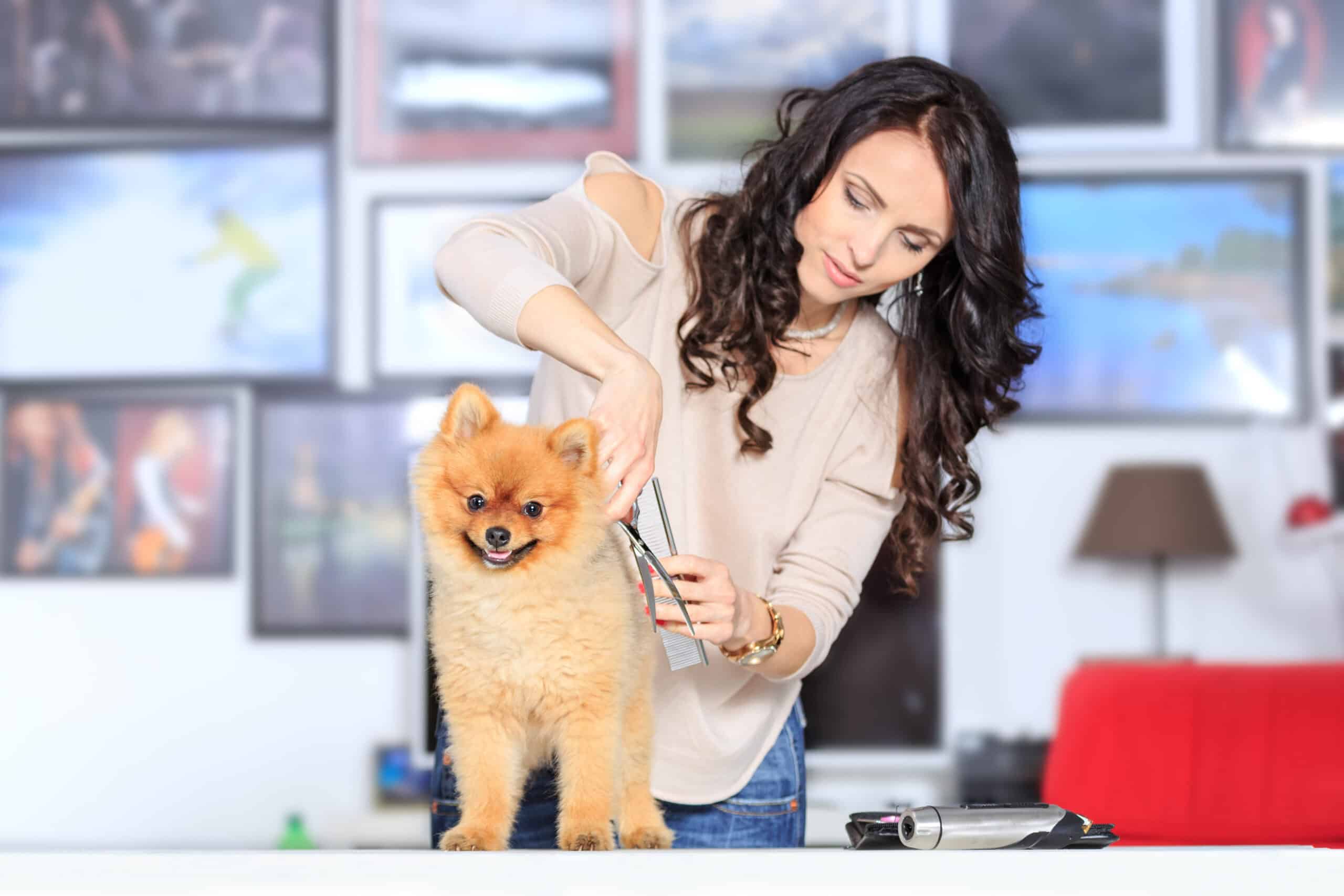
You’ve just started clipping when you notice some strange gestures: a lip lick, the white’s of the dog’s eyes, a paw lift, and maybe even raised hackles. Are these just random behaviours, or is your canine client trying to tell you something important?
If you’re a professional groomer or pet carer attempting at-home grooming, understanding what stress signals are isn’t just helpful, it’s essential for ethical, welfare-focused care, and safety. Yet surprisingly, many of these subtle signs go misinterpreted and/or ignored until a dog escalates to more severe stress behaviours like growling, lunging and/or snapping. In many cases, the dog may be blamed for being “naughty”, unhinged even, when the reality is that they have been pushed to the point they have no other option but to respond more severely.
Let’s change that. In this guide, we’ll explore the science behind canine stress signals, what they mean during grooming sessions, and how behaviour-based approach can transform the experience for both you and the dogs in your care.
Why Stress Signals Matter
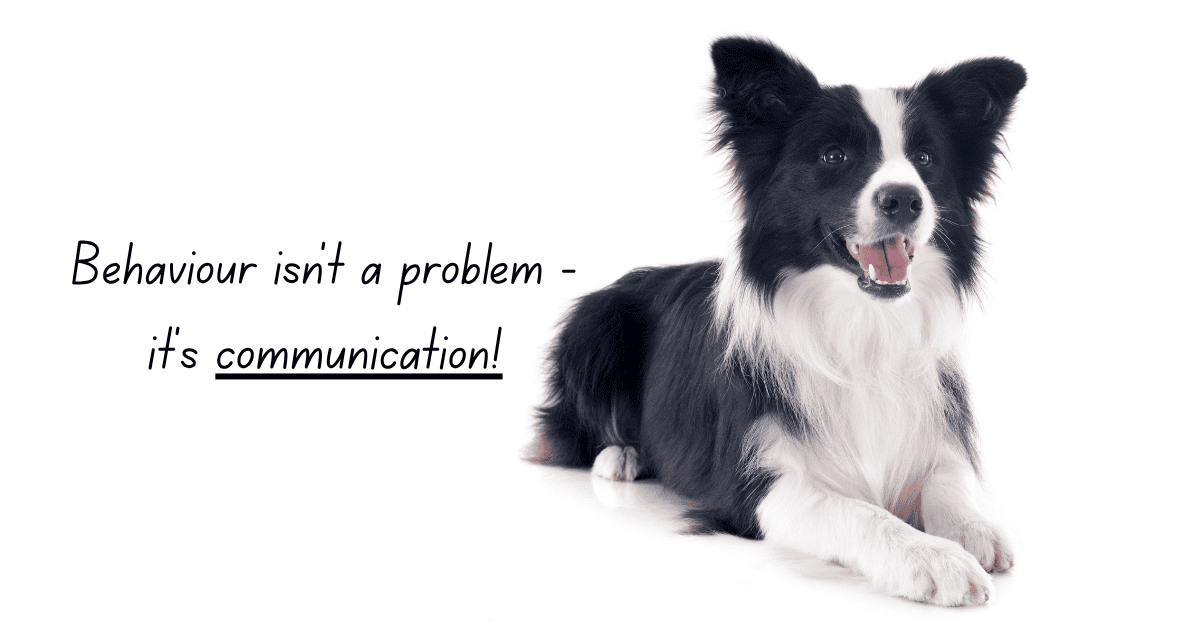
Dogs can’t tell us in words when they’re feeling uncomfortable, anxious, or overwhelmed. Instead, they rely on communicating through their own language – a language that involves a series of body language gestures and vocal cues. When understood and translated, we can prevent an escalation of stress and fear, helping to reduce trauma and encourage cooperation with grooming tasks which instantly makes the environment safer, and more enjoyable for all involved.
The risks are a real issue:
- For Groomers – Recognising early signals reduces bite risk, improves groomer and dog safety, and allows you to work more efficiently with calmer dogs.
- For Carers – Understanding these signals helps you to make the right choices for your dog, in every context, further helping to reduce the amount of stress your dog is under day-to-day. It can also help the same way it does for groomers should you learn how to groom your dog at home as well.
- For Dogs – Early intervention prevents the need for any (if any at all) restraints, reduces anxiety, increases comfort, and builds positive associations with not only grooming, but with physical human contact.
Research shows that dogs who experience high-stress during grooming can develop long-term anxiety around the process, making future sessions progressively more difficult.
But here’s the brilliant part, when we recognise and respond to early stress signals, we can often prevent this cycle entirely.
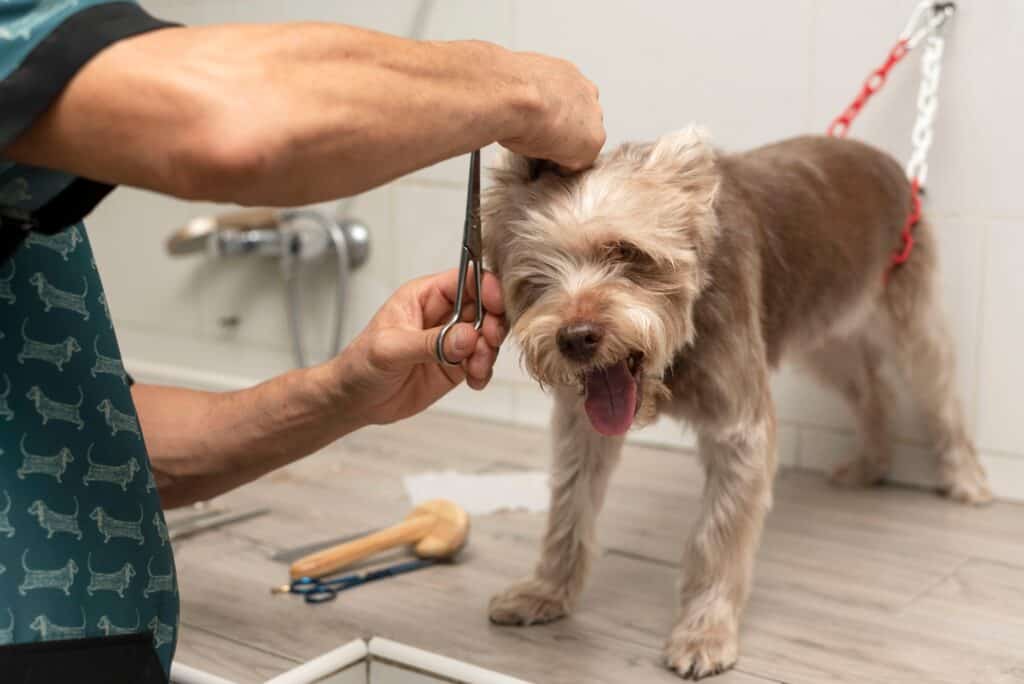
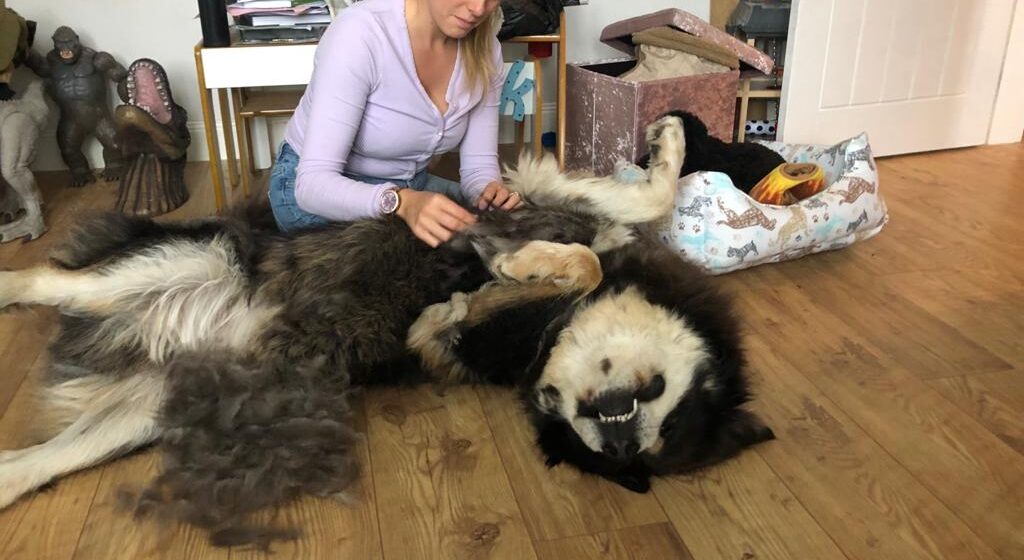
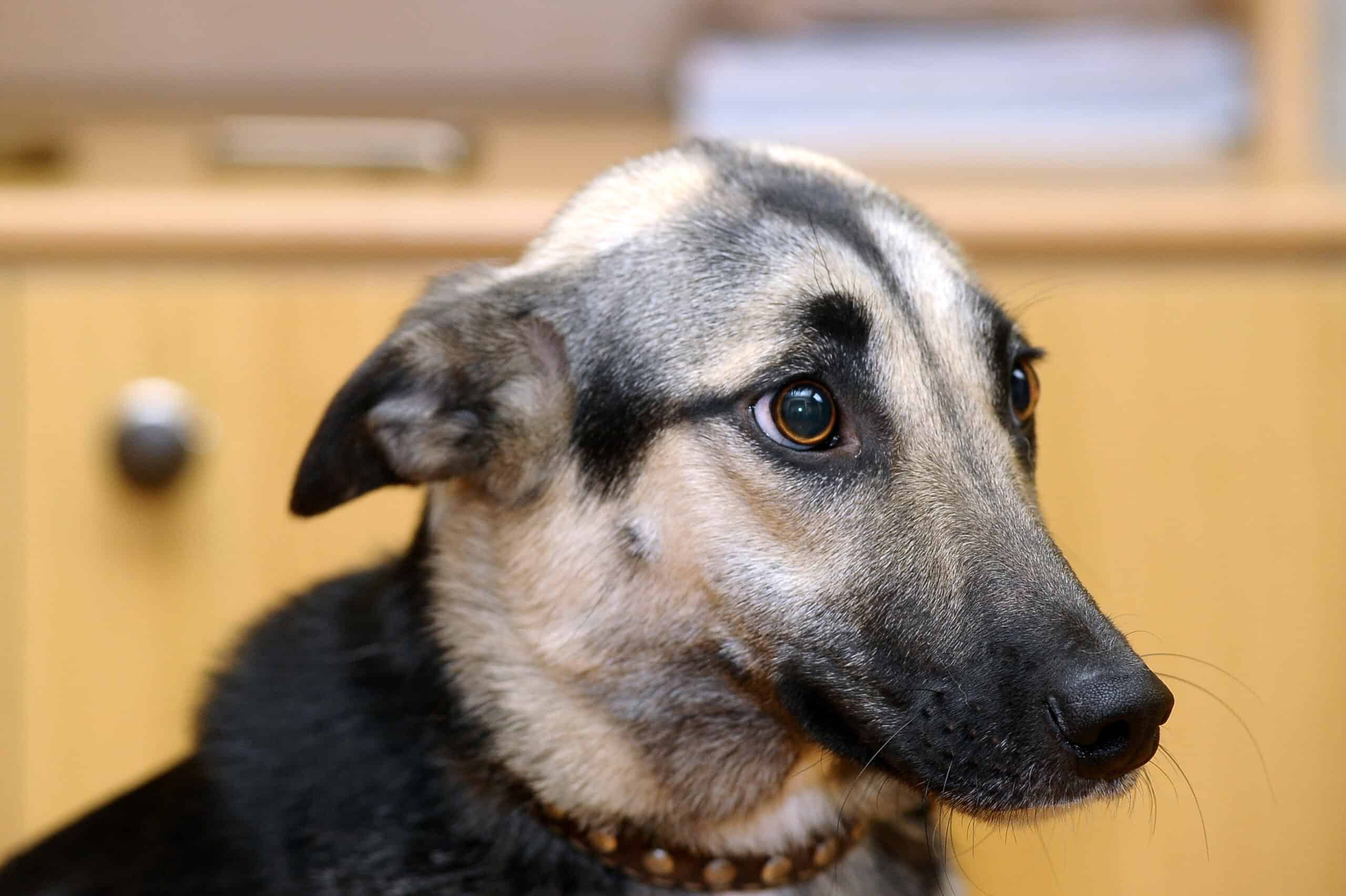
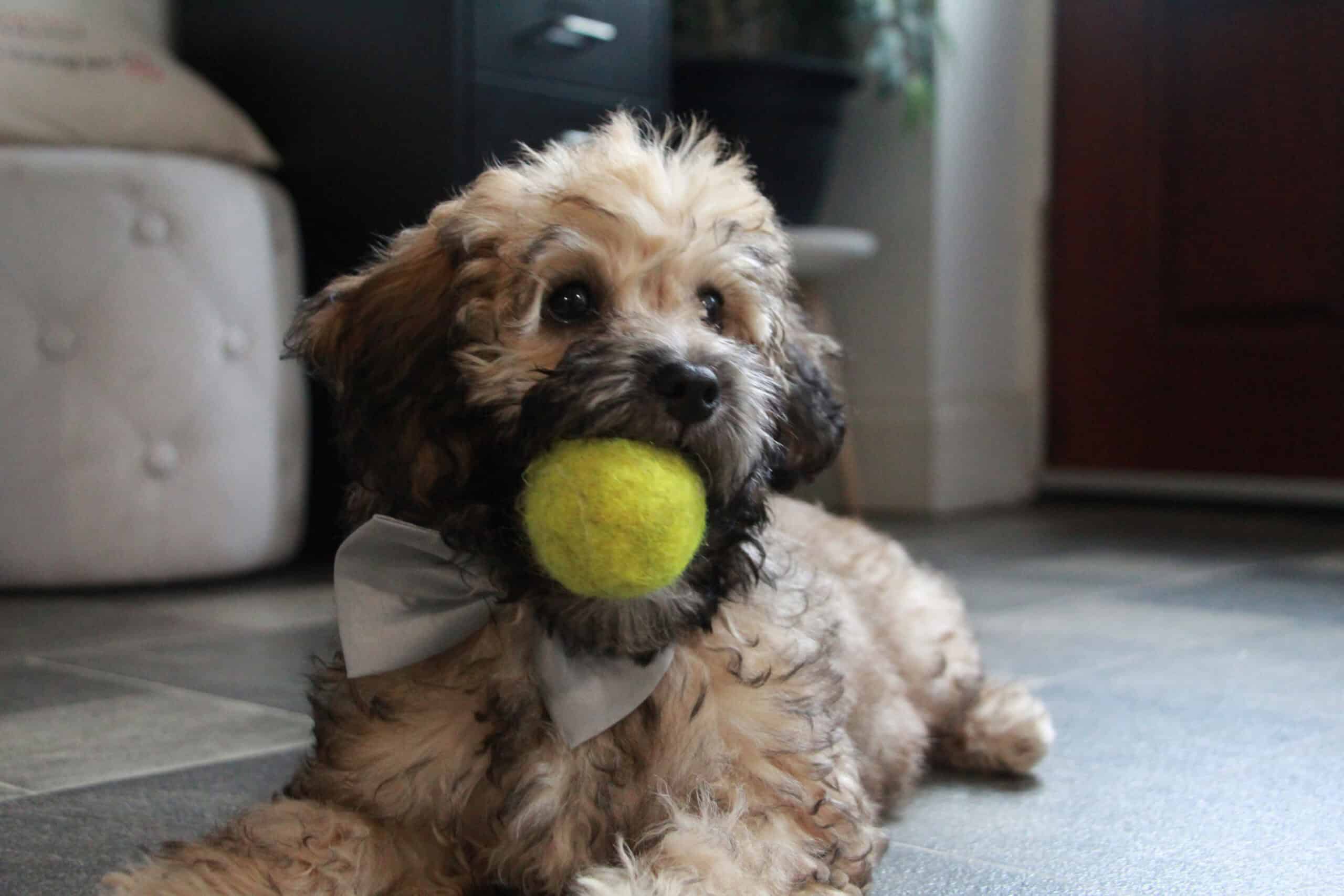
This dog is displaying various stress signals, can you spot them?
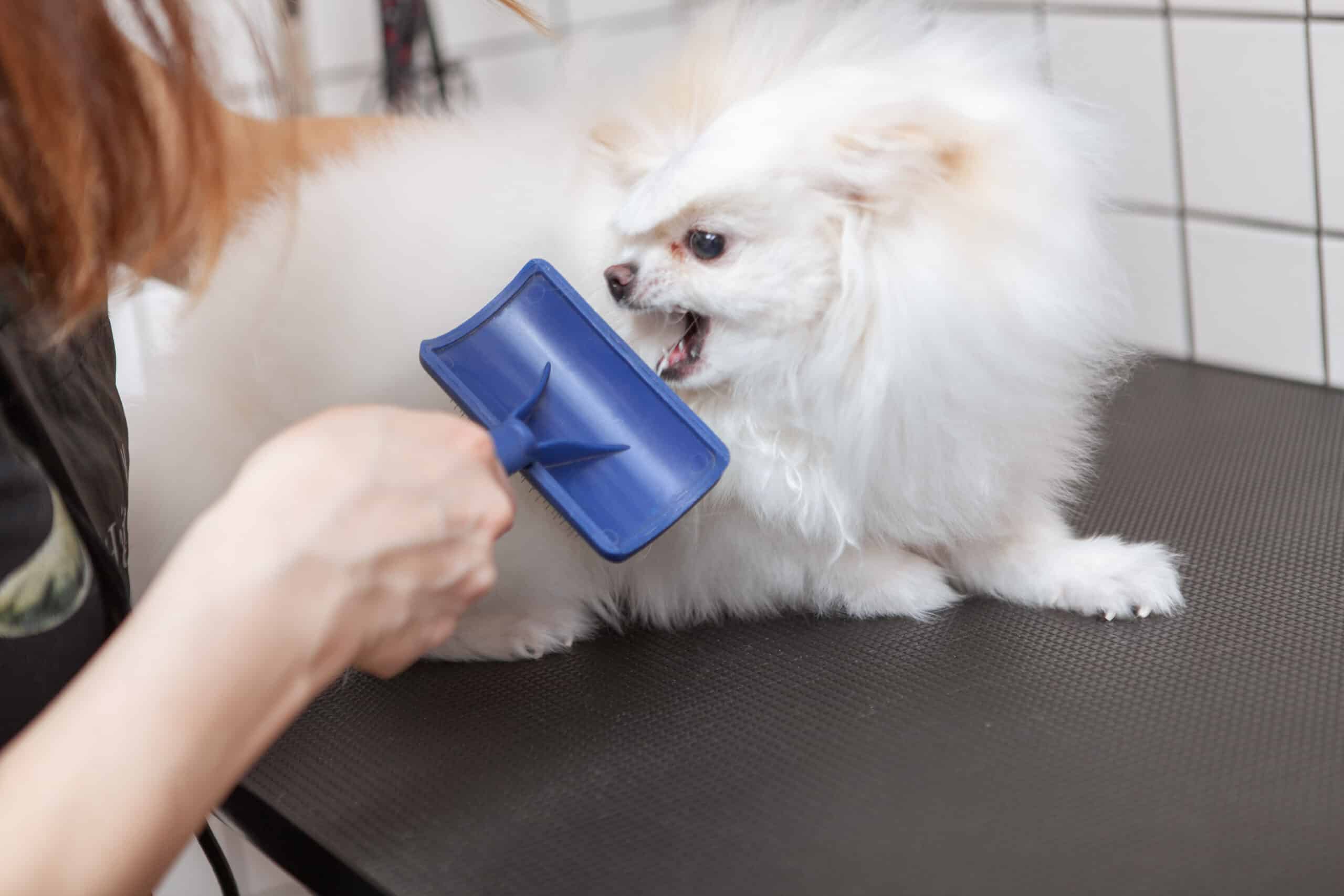
Most people recognise obvious distress (barking, lunging, or cowering), but dogs communicate discomfort long before reaching that point.
The Behaviour Escalation Ladder
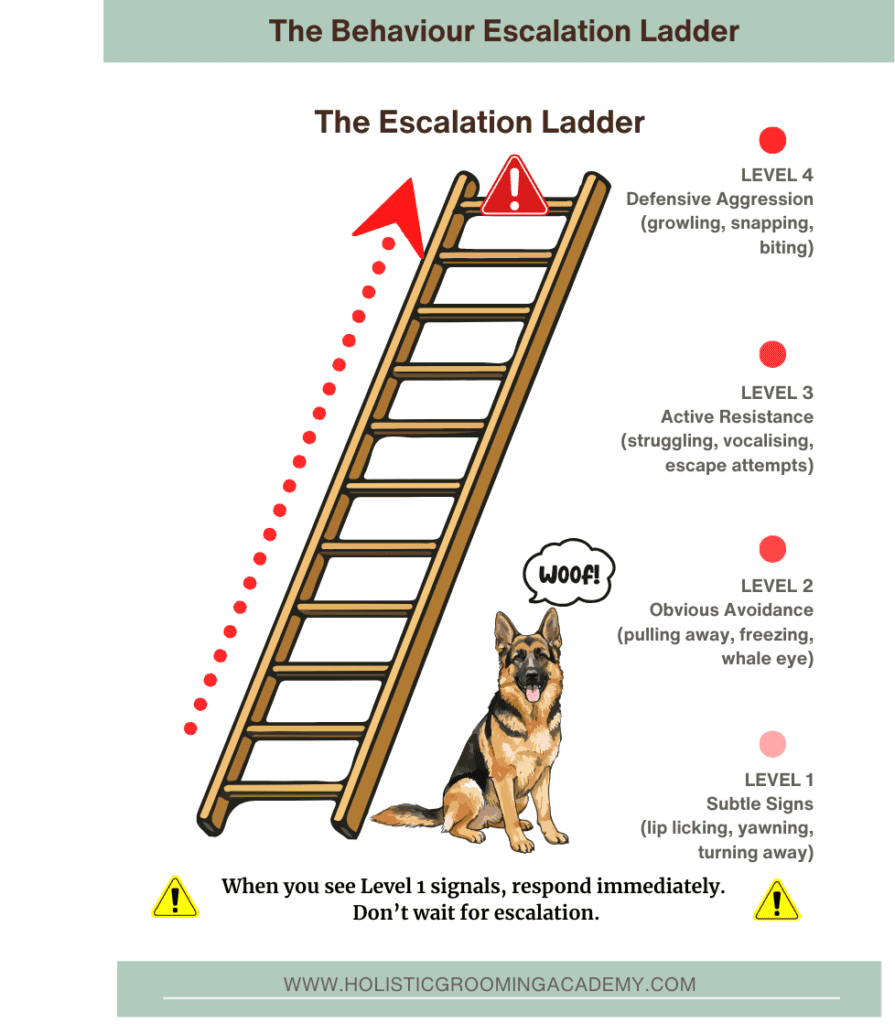
There are various visual guides designed by behaviourists that help to explain how behaviours escalate in dogs, and what they might mean.
To avoid breaching any Copyright laws, I decided to design my own for students of The HGA to use in their own salons.
What happens when we miss the signs?
The purpose of the ladder is to help groomers identify the process in behaviour, and when to stop grooming activities – failing to identify the build up of stress puts both the groomer, and the dog at risk of injury (and trauma).
Not matter what you might think, seldom does a dog “bite out of nowhere”, more often than not, a dog will have displayed various subtle cues on the lead up to a significant event, that the groomer has failed to identify.
My behaviour-led approach focuses on responding at Level 1 to prevent stress from escalating.
This isn’t just kinder; it’s safer, more efficient, and builds trust over time – which are vital components of cooperative care.
Better to prevent than to attempt to fix
Recognising stress signals is only half of the equation, this must be paired with the most appropriate response to help a dog regulate and feel safe.
It’s not enough that we know how to translate cues, we must also be confident in preventing a traumatic event from transpiring through a proactive approach.
It’s not acceptable to push a dog through a stressful event to satisfy our own expectations since it’s incredibly difficult (sometimes impossible) to un-do the damage caused by trauma.
Prevention really is better than cure.
After comparing behaviours to the Ladder, I encourage my students to refer to ‘The Four P’s’, to help guide them on what they should do next.
The Three P’s are:
- Pause – Stop what you’re doing immediately. Even a 5-second break can help a dog calm down, so take this opportunity to grab a cup of tea, let the dog outdoors to relieve themselves or mediate.
- Process – Ask yourself what triggered the response. Was it a tool, the body area, the speed, the noise?
- Proceed Differently – Adjust your approach based on your problem-solving results – change tools, slow down, take a longer break, reschedule to a different day (perhaps when it’s less busy?), or try a different technique.
- Prepare To Stop – sometimes, time will only add to stress. I talk about this in greater detail in my blog about time constraints here but this doesn’t mean you never work with the dog again.
Behaviour-Based Techniques That Work With, Not Against, The Dog
There’s more than one path up the mountain – in a grooming context, there is always another way of doing things – this is the magic of grooming the way we do.
If something doesn’t work? Try something else.
And conventional grooming processes do not consider the variables that exist when working with living, breathing, sentient beings.
Instead, we work with the dog and we implement different strategies that respect the universal need to feel in control to be safe, because that’s what it ultimately comes down to – emotional safety.
With this in mind, there are techniques that we teach that keep this in mind, always:
Cooperative Care Approach
Rather than pushing through stress, teach dogs they have choice and control – this doesn’t mean you are letting them think they are “alpha” (note, this is misinformation and debunked theory).
Allowing the dog agency might mean:
- Allowing the dog to move away (and rewarding them when returning)
- Using a “start button” behaviour where the dog can signal when they are ready to begin/resume
- Breaking tasks into smaller, manageable steps
- Pairing grooming activities with high-value rewards
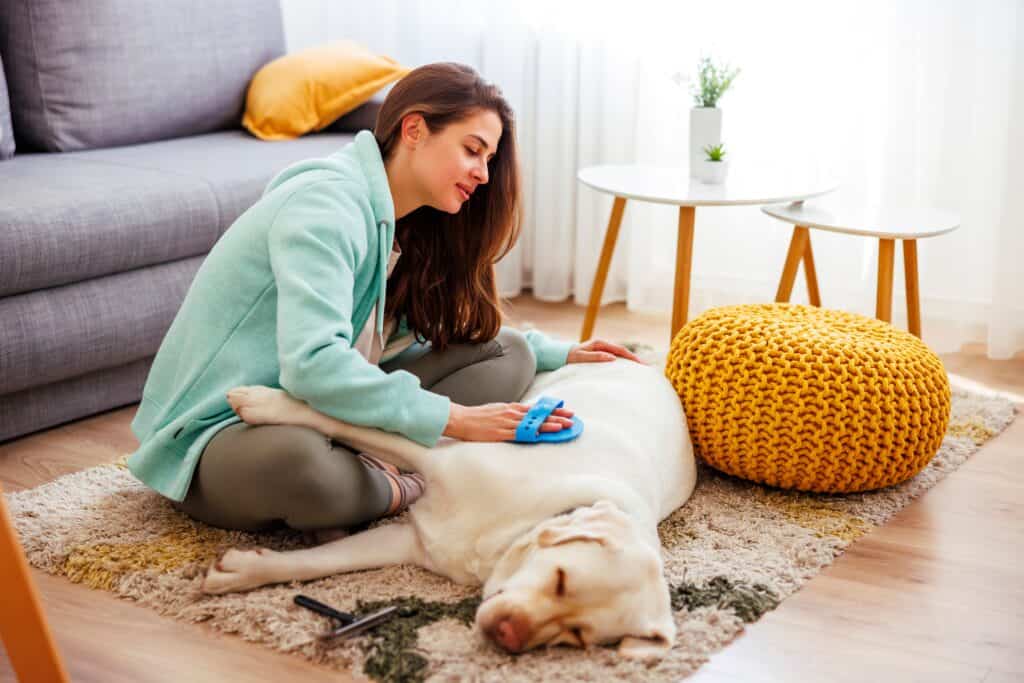
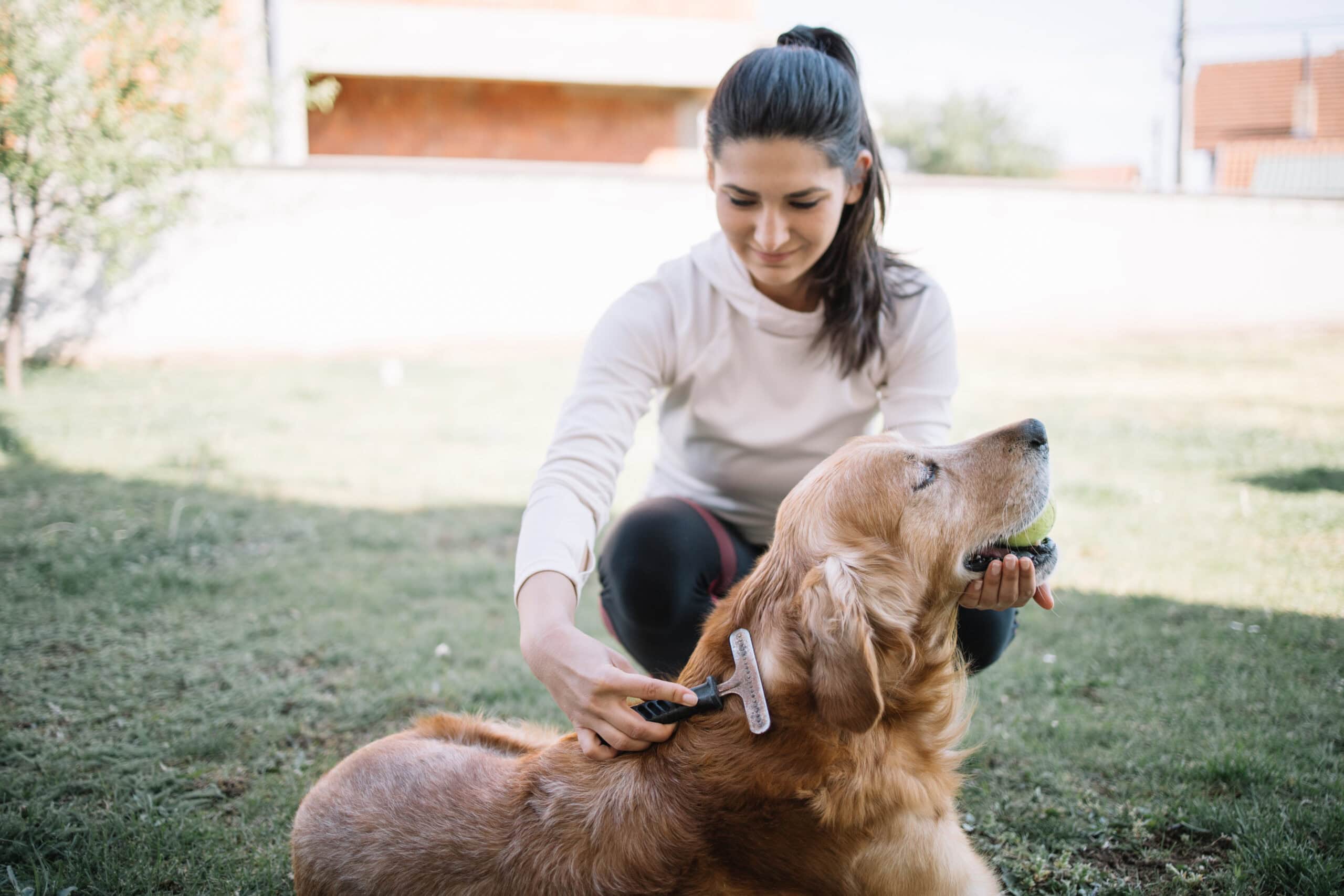
This lady is using low-stress grooming methods while she brushes this relaxed yellow labrador.
Desensitisation and Counter-Conditioning
For dogs with established grooming anxiety, systematic desensitisation (gradually introduced grooming stimuli at a level the dog can handle) combined with positive associations can completely transform the experience.
Environmental Modifications
Sometimes stress signals indicate environmental overwhelm (and in most cases, this is a contributory factor).
Things to do:
- Reduce noise (quieter dryers, clippers, reduce music volume)
- Adjust lighting (softer, less clinical – more natural lighting)
- Minimise visual stressors (other dogs, window access, busy surroundings)
- Consider temperature and overall comfort (humidifiers, air-conditioning units, central heating)
Case Study – Rooster

Rooster was a 4-year-old Yorkshire Terrier who was considered by former groomers as a “high bite risk”.
Since he had bitten her former groomer, the label wasn’t entirely untrue but it didn’t quite get to the root cause of why the incident occurred in the first place.
Rooster had always struggled with paw handling and absolutely hated having his nails trimmed – everything else was a breeze.
According to his former grooming records, during one particular nail-clipping session, Rooster had – “out of nowhere” – bitten the groomer and as a result, was asked not to come back. At home, issues around his paws were no different, with carer also experiencing aggressive behaviours whenever there was any attempt at clipping his nails.
The plan:
Since it was important for me to thoroughly assess how he communicated distress myself, I asked that the carer stay with me for an observation session. During this lesson, I asked the carer to interact with Rooster the way she would normally when attempting to clip his nails.
The results were as I expected.
What was really happening:
While I observed, I noticed that Rooster was displaying multiple Level 1 stress signals, not only from the moment he entered my grooming pod but during the early steps of attempting to make physical contact.
Including:
- Lip licking whenever he thought his carer got too close
- Paw lifting and pulling back as soon as carer gestured to touch his feet
- Whale eye and head turning during any interaction
- Body tension, and freezing completely when the nail clippers came out
I knew from this that Rooster’s bite would not have been as sudden as I’d been told, in fact, he was very good at expressing his anxiety.
The behaviour-based solution:
- We paused all nail trimming attempts and started him on a systematic desensitisation and counter-conditioning plan
- We taught him “paw rest” behaviour where he was encouraged to voluntarily place one of his paws on a target
- We heavily rewarded him for any calm paw handling using extremely high value treats (ham strips)
- Over several sessions, we gradually introduced the nail grinders (off, then on, then near the paw) using a bucket and an influx of treats
- We introduced light touching (Dremel on and off), extending the duration with every breakthrough – treats were spread out and offered sporadically, until eventually they weren’t required as much at all
The outcome:
6-weeks of consistent, positive counter-conditioning, Rooster was tolerating nail dremeling without restraints and stress.
We established that the use of nail clippers were never going to be an option in this case, but carer was happy to use a dremel if it meant making the experience less traumatic for Rooster.
Building Your Stress Signal Recognition Skills
Whether you’re a professional groomer or a dog carer, developing this skill takes practice but it’s worth the time and effort.
Much of your skills in observation will come from watching back your own way of working and communicating with dogs, and also watching and reflecting on videos of grooming sessions online.
To summarise ways to support your learning:
Professional Groomers:
- Video Review
Record your grooming sessions (with client permission) and watch them back. You’ll spot signals you missed in the moment, helping you to prevent an escalation of stress going forward with the dogs you are working with. - Slow Down
Rushing increases stress for you and the dog. Give yourself time to observe and respond appropriately (remember The Four P’s). - Continuous Learning
Understanding canine behaviour is a professional skill that requires ongoing development. Consider accredited training in behaviour-based grooming, such as The Behaviour Grooming Theory Course. - Create a Stress Signal Checklist
Keep a visual reminder near your grooming station of the key signals to look out for – you can download the resources referenced in this blog using the links at the bottom of this post.
For Dog Carers :
- Observe During Calm Moments
Learn your dog’s baseline body language when they’re relaxed so that you can spot changes to how they are feeling early. It would surprise you how significant this basic exercise is to understanding your dog and enhancing the carer:canine bond. - Practice Positive Handling at Home
Make physical touch a positive experience, even when you are not intending on carrying out any grooming-related activities. Regularly touch your dog’s paws, ears, and tail whilst keeping a look out for common subtle cues is crucial. Reward calm behaviours. - Choose Ethical Pet Professionals
Ask pet professionals whether they have been trained in behaviour and communication, and ask to see proof of certification. It’s not cheeky to do your due diligence to safeguard the experience your dog has. Ethical professionals should be able to discuss stress signals and cooperative care approaches openly with you, and ideally, direct you to a business page that can demonstrate this through video content – if not, ask to be present during sessions. - Advocate for Your Dog
If a groomer (or other pet pro) dismisses your concerns about your dog’s stress, find someone who prioritises their welfare. It’s not “snowflake” to want the very best standard of care for your dog – your dog deserves this and more. Don’t let outdated mindsets intimidate you into feeling overprotective or highly sensitive!
Why This Matters for the Industry
The grooming industry is at a crossroads. Social media is filled with videos of clearly distressed dogs being groomed – dogs displaying obvious stress signals that are being ignored, and in some cases, laughed at, in favour of “getting the job done”.
This isn’t just unethical, it’s unsustainable.
Dogs develop grooming anxiety, groomers face increased bite risk and burnout, and the grooming profession suffers.
The behaviour-based alternative offers a better way:
- Dogs experience less stress and build positive associations
- Groomers work more safely and sustainably
- Clients value and pay premium prices for ethical care
- The industry elevates its professional standards
At The Holistic Grooming Academy we’re committed to making behaviour-based, welfare-first grooming the baseline – not a niche.
Understanding and responding to stress signals is foundational to this approach, and in my opinion, fundamental for the wellbeing of dogs.
Next Steps
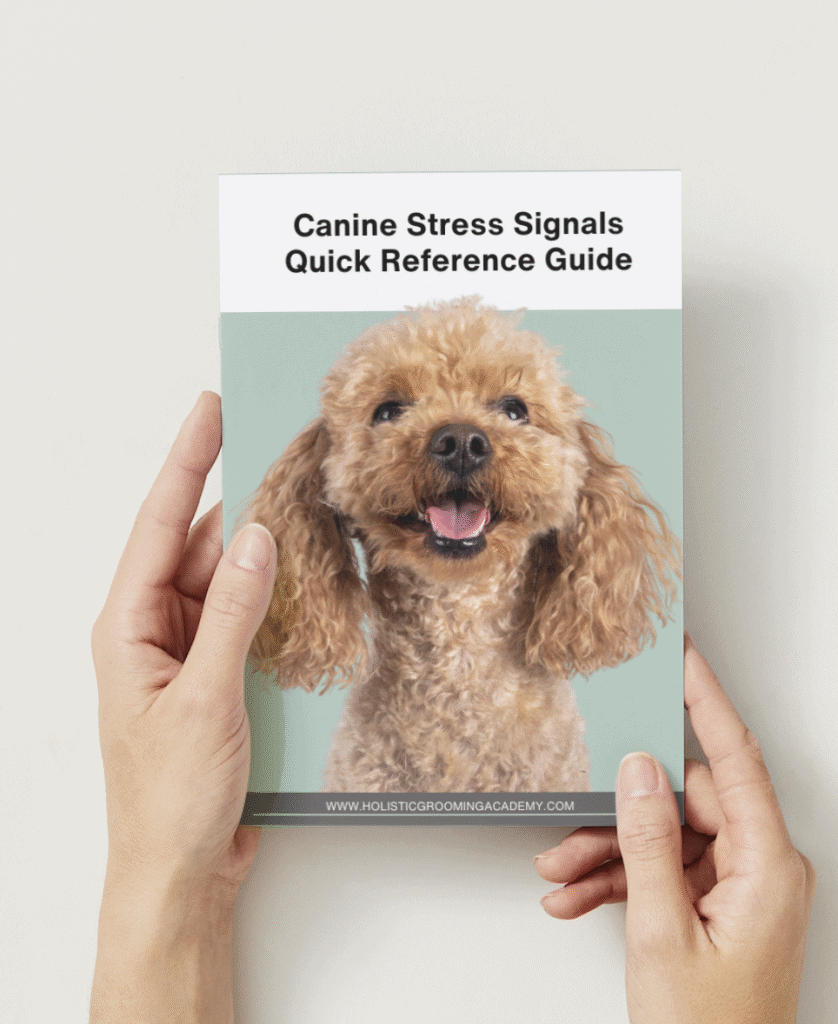
Download my FREE Canine Stress Signals Quick Reference Guide here.
If you’re a professional groomer:
Start tomorrow by committing to pausing whenever you spot a stress signal, and refer to my Canine Stress Signals – Quick Reference Guide for further support.
Notice what happens when you give dogs that moment to regulate. Track how this affects your sessions over a week.
Alternatively, why not consider deepening your knowledge with accredited behaviour grooming education?
The Holistic Grooming Academy’s, multi-award-winning Behaviour Grooming Theory Course covers everything from canine cognition, stress responses, cooperative care techniques, to practical application – all designed to create the most ethical and competent grooming environment.
If you’re a dog carer:
Begin observing your dog during everyday handling.
Can you spot their stress signals? Practice gentle, reward-based handling at home to build positive associations. Ditch any outdated, forceful pet pros that are currently in your dog’s life and make the decision to choose ethical, welfare-first professionals instead.
If you have a dog who really struggles with grooming sessions, consider investing in my latest bestselling book, ‘Help! My Dog Hates Grooming‘, available to purchase on Amazon today.
Final Thoughts
Every behaviour your dog expresses is an opportunity for you to listen to a dog and build trust.
When you learn effective canine communication (and I mean really learn) your grooming approach will not only be a more pleasant experience for all dogs, but you will begin to truly love what you do.
This isn’t about being too “soft” or taking longer, or not completing a groom ever again – it’s about stepping into our responsibility to put welfare first, no matter what.
Dogs who feel heard don’t escalate.
Dogs who have choice don’t resist against restraints, they cooperate (often without the need for them at all).
Dogs who are respected and listened to become willing participants in their own care.
Ready to step into your responsibility?
Join The Holistic Grooming Academy’s FREE community over in Skool and get support from professionals and carers who are actively seeking to make holistic grooming the new grooming standard.
Inside, you can gain access to a range of amazing resources straight away, or enrol on one of our courses to further advance your learning.